


The Iron Fist in the Andes

What a Fujimori Presidency Means for Latin America’s War on Drugs
eyesonguyana
June 2026 – In one of the closest elections in Peru’s modern history, Keiko Fujimori has clawed her way to the presidency by a margin so thin it can barely be measured — a few hundred votes out of nearly 20 million cast. After three failed bids stretching across fifteen years, the 51-year-old daughter of the late authoritarian president Alberto Fujimori has finally broken through. And she intends to govern like someone who has been waiting her entire life for this moment.
Her message was never subtle. “Justice won’t be afraid,” she declared on the campaign trail. “The most important thing is to have the will to use force to be able to confront criminals, these scum who are killing us.” Voters in a country rattled by nine presidents in a decade responded — barely, bitterly, but they responded.
Now the hemisphere is watching. Because if Fujimori delivers on even a fraction of what she has promised, her presidency could become the linchpin of the most ambitious anti-narcotics coalition the Americas has ever seen.
A Nation on the Edge — and at the Center of the Drug Map
To understand why Fujimori’s election matters beyond Peru’s borders, one must first understand where Peru sits in the narcotics supply chain. Peru is the world’s second-largest producer of coca leaf, the raw material for cocaine, and the Andean highlands and jungle lowlands of the country remain deeply infiltrated by trafficking networks linked to Mexican cartels, Brazilian criminal organizations, and remnants of the old Shining Path insurgency — some of which have morphed into narco-militias known as the VRAEM (Valley of the Apurímac, Ene and Mantaro Rivers) groups.
Related Posts:




For years, Peru’s political instability — impeachments, imprisonments, resignations — created a vacuum that criminal organizations exploited with ruthless efficiency. Cartels do not need a strong state; they need a distracted one. Peru gave them exactly that.
Fujimori’s platform is a direct repudiation of that era of paralysis.
What She Has Promised
Her campaign laid out an unmistakably militarized vision for public security and anti-narcotics policy. She pledged to crack down on organized crime with the full force of the state: expanding prison capacity through the construction of 20 new “factory-prisons,” modifying Peru’s penal code to grant national police greater autonomy and legal authority to pursue traffickers, strengthening border enforcement, and deploying military resources to coca-producing regions where the state has been effectively absent.
She also pledged to restore order within her first 100 days — a phrase that carries particular weight when spoken by a Fujimori. Her father, for all his authoritarian sins, is remembered by many Peruvians for having crushed the Shining Path and restored a measure of economic and social order in the 1990s. Keiko is betting that the nostalgia for that muscular governance, however uncomfortable it makes liberal observers, translates into political capital she can spend on security.
Her foreign policy framework is equally clear-eyed. “My government will seek a relationship of cooperation, mutual respect and investment promotion” with the United States, she told reporters. She welcomed the Trump administration’s renewed attention to Latin America and signaled her intention to be a willing partner — not a supplicant, but an ally — in any hemispheric effort to confront narcotrafficking.
The “Shield of the Americas” — and Where Peru Fits
Fujimori steps into a geopolitical environment that has, remarkably, aligned itself in her favor.
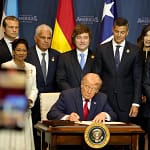
In March 2026, just months before her election, President Donald Trump convened what he branded the “Shield of the Americas” summit at his Doral resort in Florida. Gathered around him were twelve right-wing leaders from across Latin America and the Caribbean: Argentina’s Javier Milei, El Salvador’s Nayib Bukele, Ecuador’s Daniel Noboa, Chile’s president-elect José Antonio Kast, Bolivia’s Rodrigo Paz, Paraguay’s Santiago Peña, Panama’s José Raúl Mulino, the Dominican Republic’s Luis Abinader, Costa Rica’s Laura Fernández, and others.
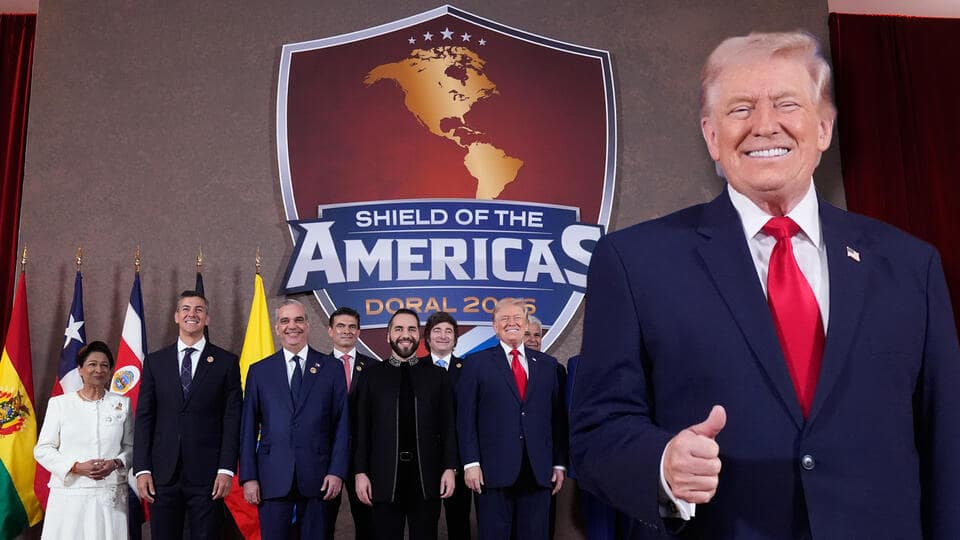
The message from Trump was brazen and unambiguous. “We’re working with you to do whatever we have to do. We’ll use missiles,” he told the assembled leaders. “You want us to use a missile? They’re extremely accurate. That’s the end of that cartel person.”
The summit formalized what had been building for years: a 17-nation counter-cartel coalition committed to using, in the White House’s own language, “hard power” against security threats. The signatories pledged intelligence sharing, military cooperation, and coordinated border enforcement.
Peru — led at the time by a caretaker government — was conspicuously absent.
Fujimori’s election changes that calculus entirely. Peru is now poised to become not merely a member of the coalition, but one of its most strategically vital partners. The country sits at the heart of the Andean cocaine corridor, bordered by Colombia to the north and Bolivia to the southeast — the other two pillars of the coca triangle. A Peruvian government committed to genuine enforcement, sharing intelligence with Washington, Bogotá, and Buenos Aires, could create a pincer effect that seriously disrupts trafficking routes for the first time in decades.
Her Natural Allies: A New Right-Wing Bloc
The landscape of Latin American leadership has shifted dramatically in Fujimori’s favor. Across the region, a wave of conservative governments has displaced the leftist “pink tide” that crested a decade ago.
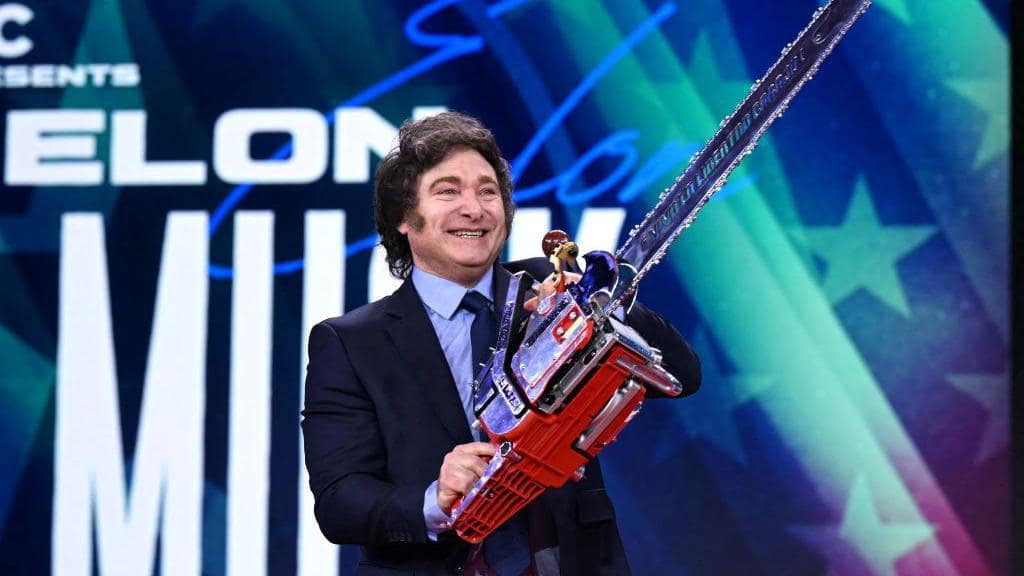
Javier Milei (Argentina) is perhaps the hemisphere’s most flamboyant right-wing leader, but he is also a committed member of Trump’s anti-cartel coalition. Argentina has increasingly become a transshipment point for cocaine heading to Europe, and Milei has shown willingness to work with Washington on law enforcement cooperation. A Fujimori-Milei axis would anchor the Southern Cone end of any regional enforcement effort.
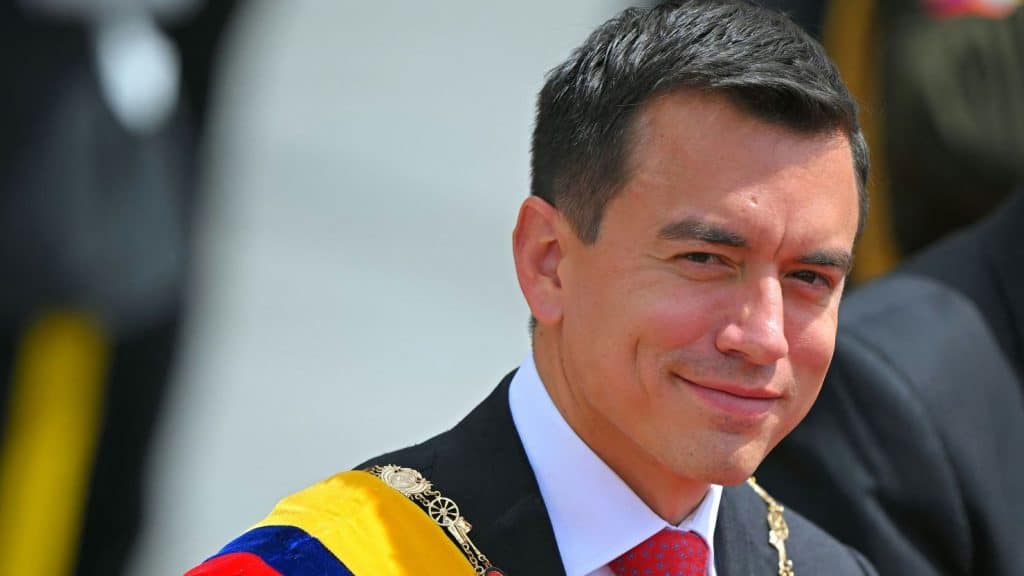
Daniel Noboa (Ecuador) has become the hemisphere’s most operationally aggressive anti-cartel president. He declared war on organized crime in 2024, deployed the military to Ecuador’s prisons after a gang takeover, and signed security agreements with the United States. Ecuador’s Pacific ports are critical to drug exports, and Noboa’s crackdown has already reshaped trafficking patterns in ways that put pressure on Peruvian routes. He is a natural and enthusiastic partner for Fujimori.
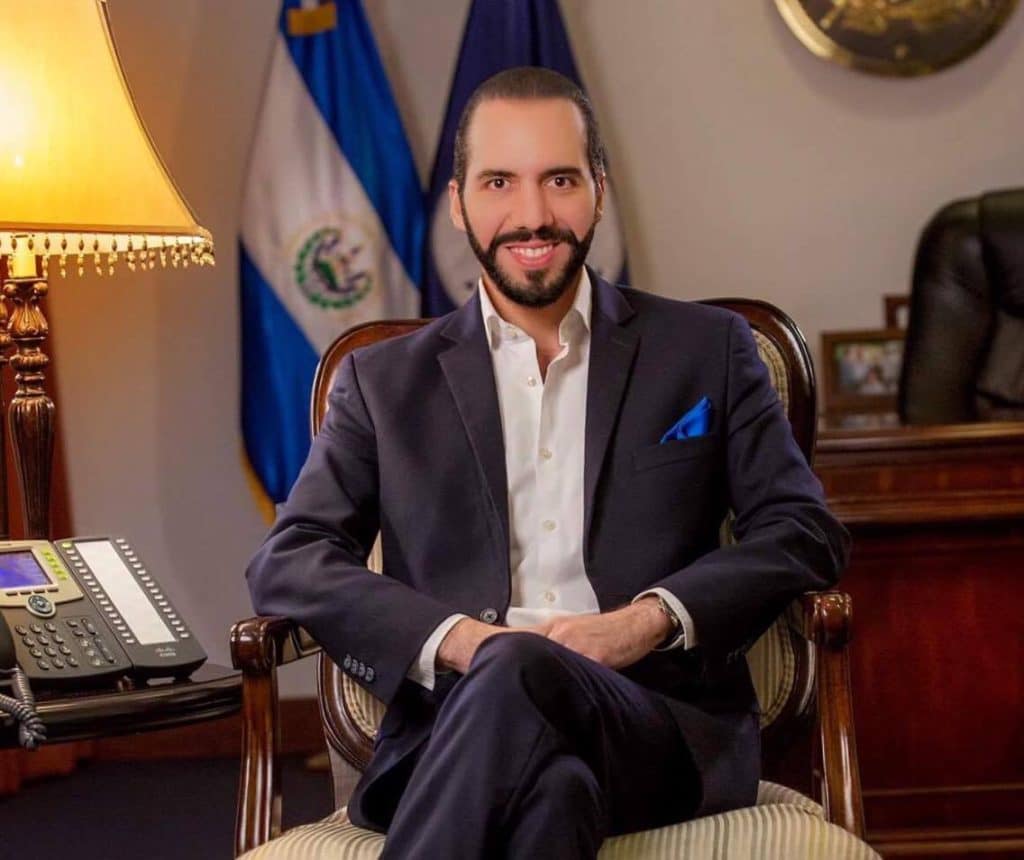
Nayib Bukele (El Salvador) transformed his country through mass incarceration of gang members, drawing both international criticism for human rights concerns and domestic approval ratings above 80 percent. While El Salvador is geographically distant from Peru’s drug production zones, Bukele’s model — state-declared emergency powers, military deployments, sweeping arrests — is precisely the template Fujimori has studied and admires.
José Antonio Kast (Chile) brings Chile firmly into the conservative bloc. As a transit country and cocaine consumer market, Chile has a direct stake in disrupting Peruvian supply chains, and Kast’s close ideological alignment with Fujimori makes bilateral security cooperation almost inevitable.
The United States under Trump is, above all, the senior partner. Washington’s interest in Peru is strategic: as the DEA and U.S. Southern Command look for reliable partners to execute the “Shield of the Americas” mandate, a Fujimori government offers the kind of willing, legally empowered, operationally capable partner that has been absent from Lima for years. Expect increased DEA presence, intelligence-sharing agreements, expanded joint operations in coca-growing regions, and potentially U.S. logistical support for interdiction missions along Peru’s river networks.
The Friction Points
No analysis would be complete without acknowledging where the “iron fist” approach is likely to encounter resistance, contradiction, and outright failure.
Human rights. The Fujimori name carries the weight of documented atrocities. Alberto Fujimori’s government was convicted of crimes against humanity for death squad operations that killed 25 people during the counterinsurgency campaigns of the 1990s. International human rights organizations will scrutinize every security operation Keiko orders. Any evidence of extrajudicial killings, forced disappearances, or military overreach in coca-producing communities will be weaponized politically — domestically and abroad.
Corruption. Peru’s security institutions have been profoundly corrupted by narco money. Expanding police and military powers without simultaneously cleaning up those institutions risks empowering the very people who protect trafficking networks. Her father’s government, for all its security gains, was also a masterclass in state corruption. Keiko must navigate that inheritance carefully.
The Colombia variable. Colombia’s President Gustavo Petro — who remains in office until 2026 elections resolve his country’s direction — has actively opposed militarized anti-drug approaches, proposing instead to treat drug consumption as a public health matter. Colombia remains the world’s largest cocaine producer. Any hemispheric strategy that doesn’t engage Bogotá meaningfully is missing a leg. If Colombia shifts right in its own upcoming election, the coalition becomes formidable; if it doesn’t, there is a structural gap in the strategy.
Mexico. The Sinaloa and Jalisco New Generation cartels maintain distribution networks that reach into Peru. Mexico, under President Claudia Sheinbaum, has been deeply suspicious of U.S. pressure and resists external involvement in its territory. The cartels’ command-and-control structure ultimately runs through Mexican soil — a reality that no amount of Andean enforcement alone can fully address.
What History Tells Us
The war on drugs has defeated every president who has declared it. Nixon, Reagan, Calderón, Santos — none of them broke the cartels. Some reduced violence; some displaced it; none eliminated it.
What they learned, expensively, is that supply-side enforcement works best when paired with demand reduction in consuming countries, economic alternatives for coca-growing communities, and institutional reform that removes corruption from the security apparatus. The “Shield of the Americas” model, with its emphasis on missiles and military force, risks repeating the pattern: short-term disruption, long-term adaptation by criminal organizations.
Fujimori’s strongest card is not the iron fist — it is the coalition. A synchronized, multinational approach that shares intelligence, closes border gaps, disrupts financial flows, and denies traffickers the fragmented governance they depend on could genuinely change the strategic calculus for the cartels. Peru has never been part of such a coalition before. The fact that its new president walked into office on the same stage as Milei, Noboa, Bukele, Kast, and Trump is not theater. It is infrastructure.
The Verdict
Keiko Fujimori won the narrowest of victories in a country exhausted by instability. She carries a complicated inheritance: a father whose authoritarian methods are both condemned and, by many Peruvians, quietly nostalgized. She governs with a slim mandate, a polarized congress, and a region watching to see whether conservative solidarity translates into policy or merely into photo opportunities.
But the geopolitical moment is real. Latin America has not been this ideologically aligned on the right in decades. The United States has not been this operationally engaged in hemispheric security since the Cold War. And Peru — at the geographic, logistical, and economic center of the coca trade — has not had a government this explicitly committed to disruption in recent memory.
“My role,” Fujimori said during the campaign, “will be to encourage the United States to once again participate more actively.”
For the cartels, that sentence should be the most alarming thing she has said yet.
The results of Peru’s 2026 presidential election were still being officially certified at time of publication. Fujimori held a lead of approximately 50.002% with over 98% of votes counted.