


How Guyana Turned Oil Into Opportunity

And the One Advantage Suriname Doesn’t Have
Two neighbors, one offshore basin, two very different starting points. Guyana got a five-year head start and a language advantage. Here’s what it actually did with them — and what’s left for Suriname to copy.
eyesonguyana
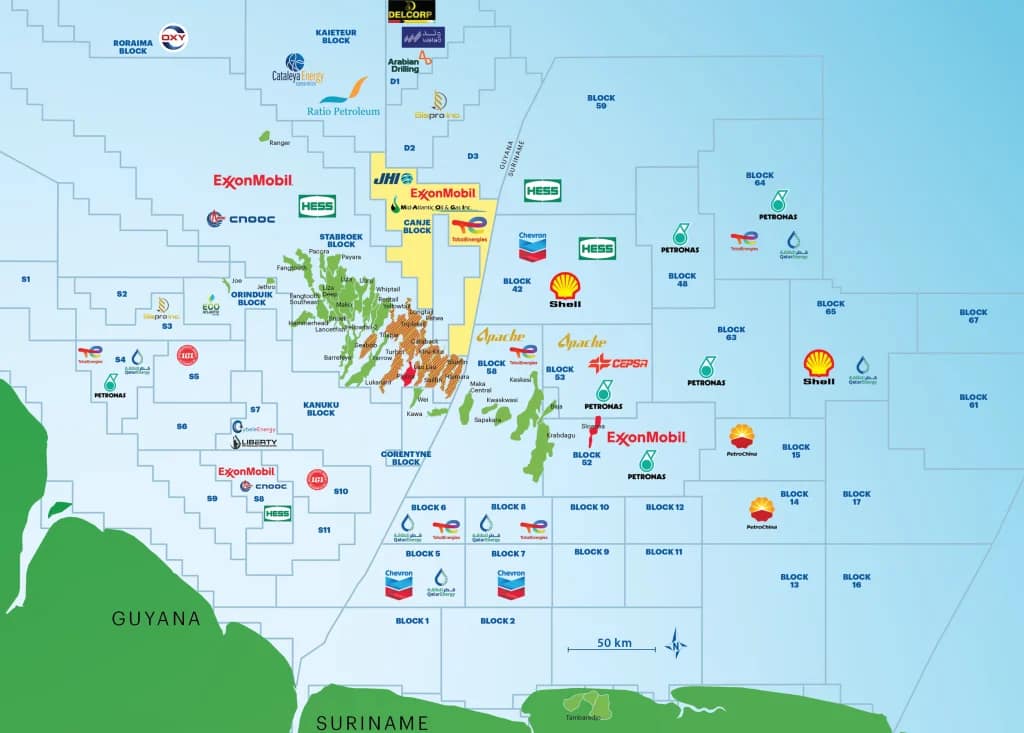
Amsterdam, July 28, 2026 – Guyana and Suriname share more than a border and a geological formation. Both are small, historically overlooked South American nations that suddenly found themselves sitting on some of the largest offshore oil discoveries of the century. Both inherited colonial-era institutions built for very different economies. And both face the same fundamental question: will the wealth flowing in from Houston, Paris, and Kuala Lumpur end up in the hands of local workers, or will it pass through the country on its way to someone else’s payroll?
Guyana got there first — production started in 2019 — and its output has already passed 900,000 barrels a day. That head start matters. But the more instructive part of Guyana’s story isn’t the oil. It’s the machinery the government built, deliberately and early, to make sure Guyanese citizens weren’t just spectators to their own boom.
The Legal Backbone: A Law With Teeth
The single biggest difference between Guyana’s approach and the policy conversations still happening in Suriname is this: Guyana passed an actual law. The Local Content Act of 2021 didn’t just encourage companies to hire locally — it reserved 40 specific categories of oil and gas service work exclusively for Guyanese-owned businesses, and set hard ownership thresholds for what counts as “Guyanese”: at least 51% Guyanese voting rights and at least 75% Guyanese executive representation. Foreign firms operating in Guyana’s oil sector don’t get to decide for themselves how “local” their local hiring looks — the law decides for them.
Related Posts:








Crucially, Guyana has kept refining that law rather than treating it as finished. In June 2026, regulators closed what had become known as the “rent-a-citizen” loophole — arrangements where a company put a Guyanese name on paperwork while foreign owners kept the real control and profit. Annual compliance plans are now screened for genuine local ownership, not a token shareholder. Around the same time, with thousands of Guyanese workers now holding five to eight years of real offshore experience, the government began pushing operators toward pay parity: a Guyanese worker with the same qualifications and experience as an expatriate should be paid the same for the same job. That’s a strikingly mature stage of a local content policy to reach barely five years after the law passed — it says something about how seriously the implementation has been taken.
Building the Pipeline Before the Oil Arrived
Legislation alone doesn’t train a workforce. Guyana moved on that front early too: its first dedicated petroleum training facility opened in 2022, years before its local content push matured into 2026’s refinements. By 2025, the country had gone a step further, launching its first fully in-country training program — meaning Guyanese workers no longer need to leave the country at all to get internationally recognized offshore qualifications.

That investment is compounding. Guyana’s Board of Industrial Training had already surpassed 70% of its entire 2026 training target by just the four-month mark of the year, enrolling more than 1,600 people in programs spanning not just oil and gas but construction, manufacturing, logistics, IT, and hospitality — a deliberate acknowledgment that a healthy oil economy needs skilled workers well beyond the rigs themselves.
Making the System Usable, Not Just Legal
Guyana’s other quiet advantage is administrative speed. Starting this year, local content certification — the paperwork that proves a business qualifies as Guyanese-owned and puts it on the register international operators are required to source from — is processed in five working days for sole proprietorships, 15 days for fully Guyanese-owned companies, and no more than 21 days for anyone else, provided documentation is complete. The government has paired that with a Local Content App, giving contractors and subcontractors a direct, digital channel to post and find procurement opportunities, rather than relying on informal networks or word of mouth that tend to favor whoever already has connections.
The Advantage Suriname Doesn’t Get for Free
None of this happened in a vacuum, and it’s worth naming the advantage plainly: Guyana is an English-speaking country, a legacy of British colonial rule, operating in an industry whose global technical language, safety standards, and corporate paperwork are almost entirely in English. A Guyanese worker walking into an offshore training program is learning new technical content in their first language. A Surinamese worker — schooled in Dutch, often speaking Sranan Tongo at home — is frequently learning the same technical content and a new working language simultaneously. That’s not a minor gap. It’s the kind of structural head start that shows up in every training statistic Guyana can point to.
What Suriname Can Actually Take From This
The good news is that almost none of Guyana’s playbook depends on the English-language advantage — it depends on sequencing and seriousness, both of which Suriname can still choose.
- Legislate, don’t just aspire. Suriname’s own local content policy has been criticized by regional analysts for lacking the enforceable teeth of Guyana’s Act. Translating policy into binding regulation — with real ownership thresholds, not just encouragement — before GranMorgu reaches first oil in 2028 is the single highest-leverage move available.
- Build training capacity before production starts, not after. Guyana’s 2022 training facility predated its most sophisticated local content rules by years. Suriname’s NATIN program and Staatsolie’s Blue Wave initiative are the right foundation — the lesson from Guyana is to scale them now, while there’s still runway before 2028, not once foreign contractors have already filled the early roles.
- Digitize procurement and certification, and make it fast. Guyana’s five-to-21-day certification windows and its Local Content App exist specifically to stop informal networks and bureaucratic drag from quietly excluding smaller local firms. Suriname’s existing supplier registration portal is a start; matching Guyana’s speed and transparency would be a meaningful next step.
- Watch for symbolic compliance, and close the loopholes early. Guyana only closed its “rent-a-citizen” gap after years of operation. Suriname has the rare advantage of being able to write real-ownership requirements into its rules from the start, rather than patching them in later.
- Treat the language gap as solvable, not permanent. This is precisely where the AI-assisted training and translation tools discussed in relation to Suriname’s broader workforce challenge matter most concretely — not as a general modernization slogan, but as the specific bridge across the one real advantage Guyana had that Suriname doesn’t.
A Success Story, Not a Flawless One
It’s worth resisting the temptation to tell this as a tidy parable. Guyana’s own local content debate is still very much alive — the fact that regulators only closed the “rent-a-citizen” loophole this year is itself an admission that early compliance was often superficial, and Guyanese commentators continue to debate whether the country’s cost-recovery arrangements with its oil operators leave the government with a fair share of the underlying revenue in the first place. Guyana’s boom has also drawn real concern from economists and civil society groups about inequality, inflation in Georgetown’s housing and services market, and the environmental exposure that comes with becoming a petrostate at record speed. None of that erases what the country’s training and local content machinery has achieved — but it’s a reminder that “graceful” is a relative term, and that the job of building an inclusive oil economy is never really finished, even for the country doing it best in the region.
Suriname doesn’t need to replicate Guyana’s exact model, and it doesn’t have to replicate Guyana’s mistakes either. What it does need is the same thing Guyana had in 2021: the political will to turn good intentions into enforceable rules, years before the first barrel ships out — and the humility to keep revising those rules once they meet reality.