


The Black Gold Rush Next Door

How Guyana Could Be the Biggest Winner of the Strait of Hormuz Crisis
eyesonguyana
Amsterdam, April 14, 2026– While the world holds its breath watching U.S. Navy destroyers patrol the choke point that carries a fifth of the planet’s oil, a small South American nation tucked between Venezuela and Brazil is quietly sitting on one of the most strategically valuable oil fields on Earth — and the geopolitical cards may never have been stacked more in its favor.
Guyana. Population 800,000. GDP once dwarfed by its neighbors. Now, potentially, the oil story of the decade.
A World Desperate for an Alternative
The numbers are staggering. The Strait of Hormuz, that narrow passage between Iran and Oman, has been largely blockaded since late February 2026, when the United States and Israel launched an air war against Iran that killed Supreme Leader Ali Khamenei and triggered one of the most consequential maritime crises in modern history. Roughly 20% of the world’s oil and liquefied natural gas normally flows through that 33-kilometer bottleneck. Now it doesn’t. After peace talks in Islamabad collapsed over the weekend — with Iran demanding control of the strait, war reparations, and the right to collect transit tolls — President Trump declared an American naval blockade effective Monday morning, April 13. Brent crude surged past $100 a barrel. Analysts at Columbia University’s Center on Global Energy Policy warn that prices could remain elevated well into the end of 2026, with one senior scholar noting that “those are huge variables which are really, really unsolved.”
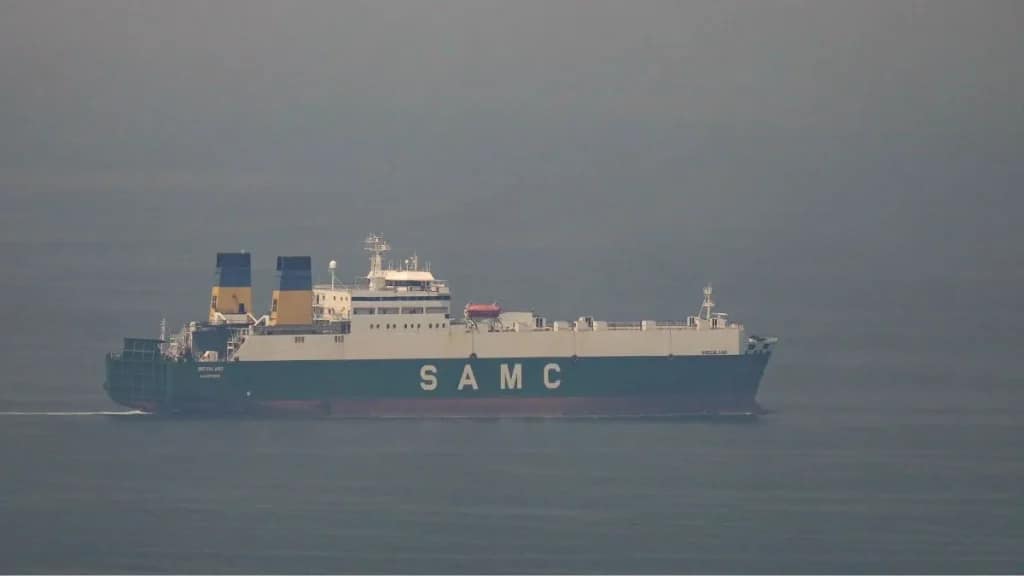
For energy-importing nations from Japan to Germany to India, the scramble to find reliable, sanction-free, geopolitically stable oil supply has become an emergency. Which brings us back to Guyana.
Related Posts:








An Oil Giant in Miniature
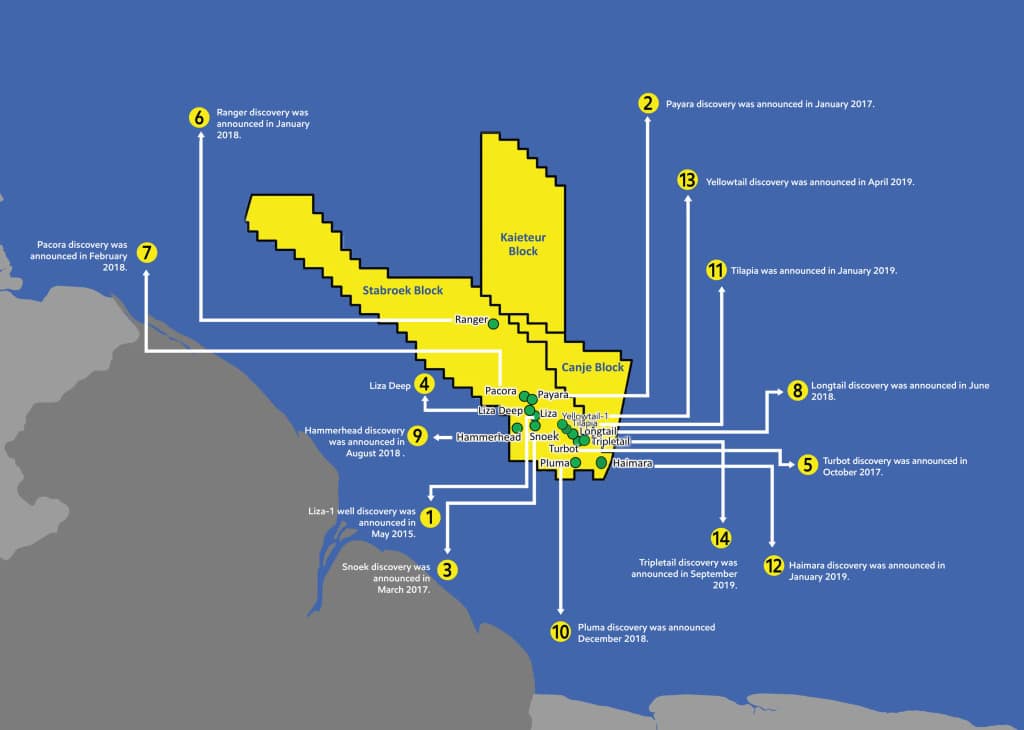
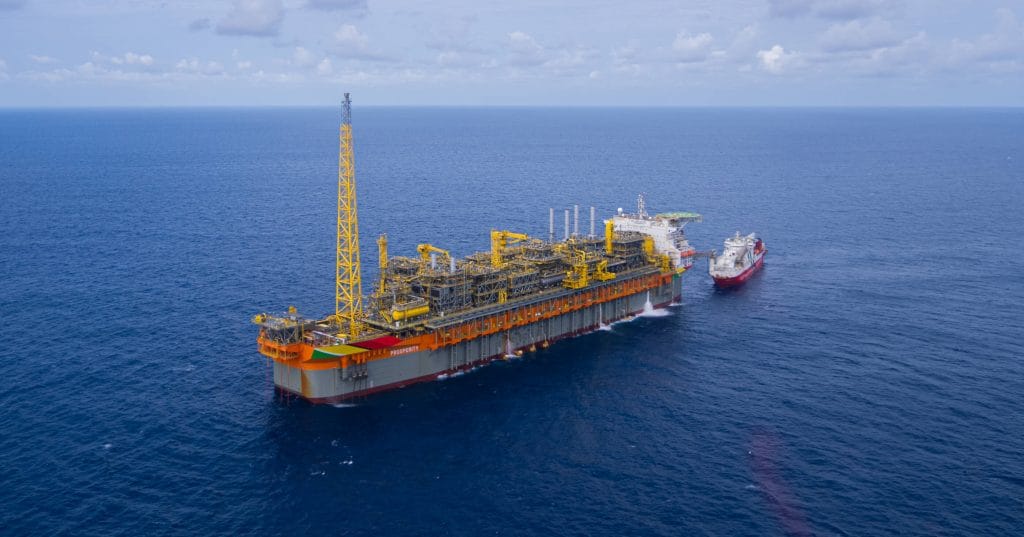
Guyana’s offshore Stabroek block, operated by ExxonMobil in partnership with Hess and the China National Offshore Oil Corporation (CNOOC), has transformed from a geological gamble into one of the most prolific deepwater oil discoveries in history. Just last November, the consortium hit a landmark milestone: 900,000 barrels of oil per day from the Stabroek block alone. A fifth offshore project, Uaru, is expected to begin operations this year, adding another 250,000 barrels per day. By the end of 2027, total installed capacity is projected to reach 1.3 million barrels per day — and by 2030, ExxonMobil envisions total production capacity of 1.7 million oil-equivalent barrels per day from eight developments.
To put that in perspective: Guyana, a nation the size of Idaho, is on track to produce more oil per capita than Saudi Arabia.
And its crude — marketed as “Golden Arrowhead” — has qualities that refiners love: light, sweet, low-sulfur. It’s the kind of oil that commands premium prices and is easy to process into the high-value products the world needs most.
Geography as Destiny
Here is where geopolitics meets geology in a way that should make every energy minister in the Atlantic world take notice. Guyana sits approximately 2,500 miles from the U.S. Gulf Coast refineries — a straightforward, unimpeded Atlantic route with no hostile navies, no contested straits, no Iranian mines lurking in the water. Tankers can load at Guyana’s offshore floating production vessels and arrive in Houston, Rotterdam, or Singapore without passing through a single geopolitical flashpoint.
In the current environment, that kind of supply certainty is priceless.
Compare this to the alternatives. Gulf state producers — Saudi Arabia, the UAE, Kuwait, Iraq — all send their crude through the very strait that is now either mined, blockaded, or under active military contest. Even if the Hormuz situation resolves in the coming weeks, as U.S. Energy Secretary Chris Wright optimistically suggested, the episode has exposed a vulnerability that no long-term energy security planner can ignore. Buyers who diversify away from Hormuz-dependent supply chains are making a rational bet — and Guyana is one of the very few nations with the production scale to absorb that demand.
The ExxonMobil Factor
There is another element here that is almost too neat to be true: ExxonMobil, an American company, is the lead operator and 45% stakeholder in the Stabroek block. In a world where Trump’s administration has made energy dominance a foreign policy instrument — pressuring allies to buy American LNG, wielding sanctions as economic weapons, blockading Iranian ports — Guyana’s oil is, in a meaningful sense, American-aligned oil.
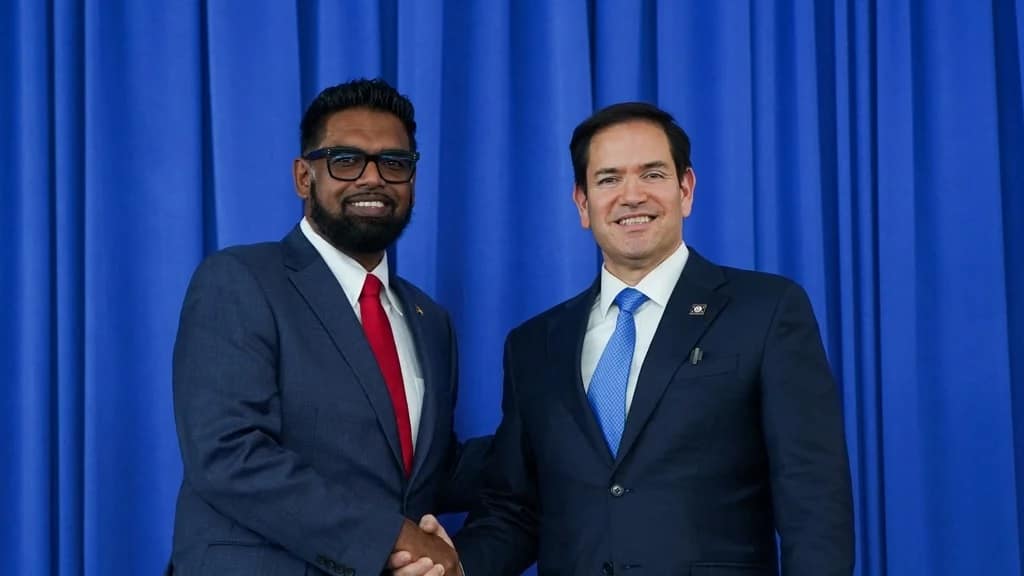
This isn’t lost on Washington. When Secretary of State Marco Rubio visited Georgetown in March 2025, he did so conspicuously, standing alongside Guyanese President Irfaan Ali to warn Venezuela that any aggression toward Guyana would trigger consequences. The diplomatic signal was clear: U.S. investment in Guyana’s oil fields is U.S. strategic interest, full stop.
For buyers in Europe and Asia seeking to curry favor with Washington — or simply to ensure supply continuity during this period of extraordinary Middle Eastern instability — Guyana’s barrels carry an implicit geopolitical endorsement.
The Challenges Are Real
None of this means Guyana’s ascent will be frictionless. The country faces genuine infrastructure constraints. Its oil is produced on floating vessels far offshore, and export capacity, while growing rapidly, still cannot be scaled overnight to meet a sudden demand surge. Guyana’s downstream infrastructure — local refining capacity, port facilities, pipeline networks — remains nascent. Georgetown is not Houston.
There are also governance questions. Guyana is navigating an extraordinary resource boom with relatively thin institutional capacity, and managing the curse of sudden oil wealth — the so-called “Dutch disease” — is a challenge that has felled larger nations with deeper bureaucratic roots. Revenue management, transparency, and inclusive development remain live concerns that investors and trading partners will watch closely.
Finally, CNOOC’s 25% stake in the Stabroek block creates an interesting wrinkle. China, which imports nearly a third of its oil through the Strait of Hormuz and has been urging calm throughout the Iran crisis, has a direct financial interest in seeing Guyana’s production ramp up — and in ensuring its own access to that output. How that triangular relationship between Washington, Beijing, and Georgetown evolves may be one of the more fascinating geopolitical subplots of the coming years.
The Venezuela Wildcard — Now Neutralized
And then there is the matter that, until very recently, kept executives and diplomats quietly awake at night: Venezuela.
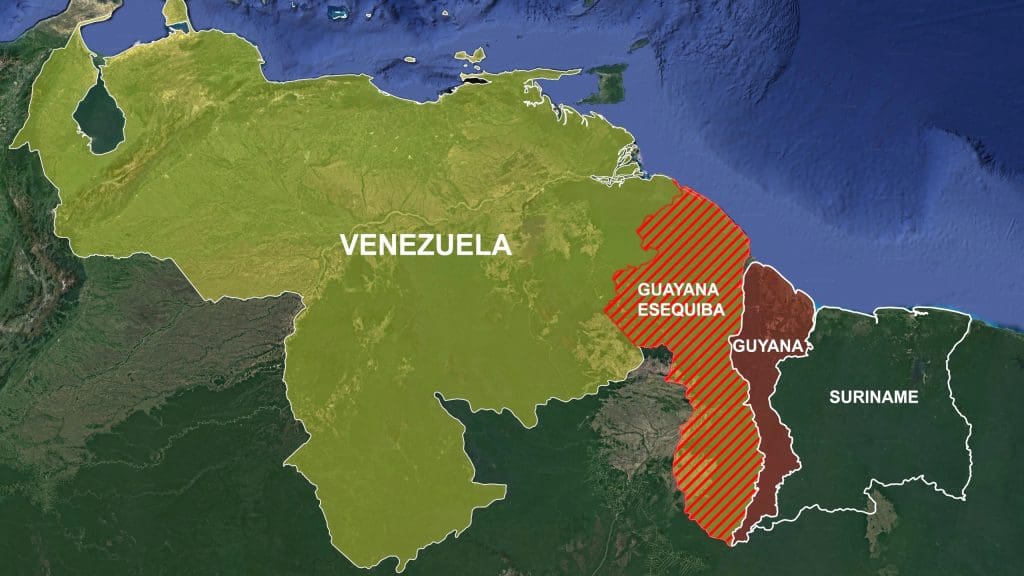
For years, the specter of Nicolás Maduro’s territorial ambitions haunted Guyana’s oil sector. In December 2023, Maduro held a referendum claiming two-thirds of Guyana’s territory — the resource-rich Essequibo region — and began massing troops near the border. The Essequibo dispute is over a century old, rooted in an 1899 arbitral tribunal that awarded the territory to British Guiana. Venezuela never accepted the ruling. Maduro, facing domestic implosion, saw revisionist nationalism over the Essequibo as a political lifeline. The International Court of Justice issued binding orders prohibiting Venezuelan elections in the disputed territory; Caracas ignored them. Analysts noted that the Essequibo claim was likely more bluster than actionable aggression — but with Venezuela amassing troops and mining the region’s waters with nationalistic rhetoric, the risk was non-trivial.
Then came January 3, 2026.
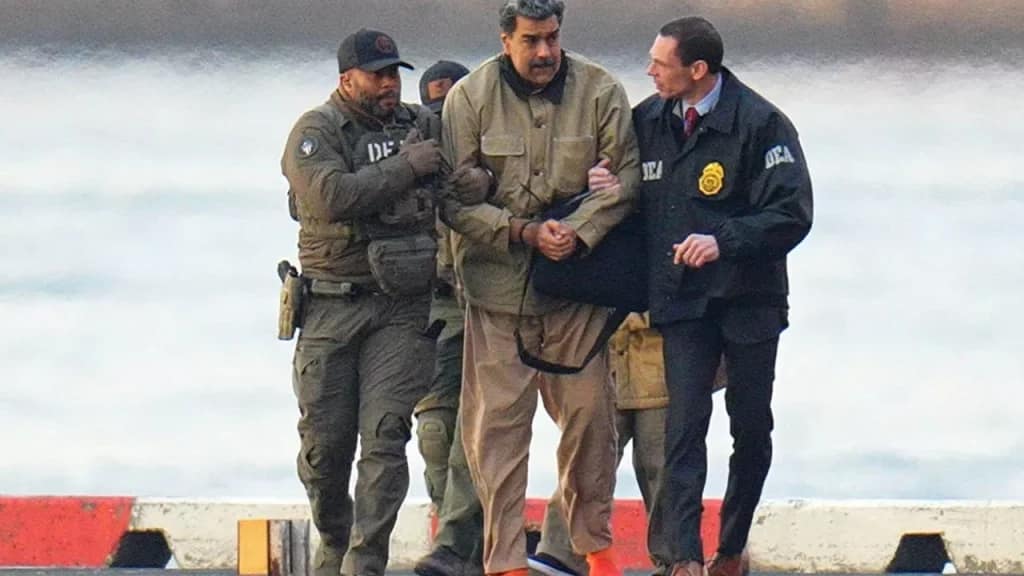
In the early morning hours of that day, U.S. Delta Force operators breached a heavily fortified compound in Caracas. By 3:30 a.m., Nicolás Maduro and his wife, Cilia Flores, were in U.S. custody, en route to Guantanamo Bay and then to New York, where they face charges including narco-terrorism conspiracy and drug trafficking. Operation Resolve, as the raid was called, sent shockwaves through the hemisphere. Trump announced that the United States would run Venezuela “until such time as we can do a safe, proper, and judicious transition.” Vice President Delcy Rodríguez was sworn in as interim president — a Venezuela now operating under the weight of U.S. military intervention, economic collapse, and hyperinflation that ended 2025 at nearly 270%.
The effect on the Essequibo dispute was immediate and profound. Allen Good, director of equity research at Morningstar, put it plainly: Maduro’s Essequibo claims had always been more noise than actionable threat, but now, “with the US’s intent to control the country, any action by Venezuela becomes even more remote, removing a nuisance for Exxon and Guyana.” Even analysts who see the dispute as lingering — a century-old claim doesn’t disappear with one regime’s removal — acknowledge that Caracas, under intense U.S. pressure and in the midst of political convulsion, is in no position to be making territorial noise against a neighbor backed by Washington.
For Guyana, this is nothing less than the removal of an existential overhang. The billions of barrels sitting beneath the Essequibo’s waters — and the investments tied to extracting them — can now be developed without the background hum of Venezuelan military brinksmanship.
The Moment Is Now
History has a habit of creating moments that reward the prepared. Guyana has been preparing, quietly and methodically, for years — licensing blocks, attracting investment, building capacity, managing its sovereign wealth fund. The global energy map is being redrawn in real time, and Guyana finds itself at a crossroads that its founders, navigating colonial sugar economics, could never have imagined.
The Strait of Hormuz crisis will eventually resolve — straits always do. But the energy buyers, analysts, and governments now frantically redrawing their supply chain maps will remember this moment. The questions being asked in boardrooms from Tokyo to Frankfurt right now — where else can we get reliable, Atlantic-basin, U.S.-aligned oil? — do not have many compelling answers.
Guyana has one.
The author notes that geopolitical analysis involves inherent uncertainty. Investments, trade flows, and military situations can shift rapidly.