


Turning the Tide

Why Guyana’s Plastic Crisis Is a Foreign Investor’s Greenfield Opportunity
By the time Guyana’s oil economy reaches full stride, the country faces a paradox: becoming one of South America’s fastest-growing economies while simultaneously drowning in its own waste. For the shrewd foreign investor, that contradiction is not a problem — it is a business model.
eyesonguyana
A Nation at a Crossroads
Guyana is booming. The discovery of massive offshore oil reserves in the Stabroek Block has propelled the country into one of the world’s fastest-growing economies, drawing multinational capital and transforming Georgetown’s skyline. Yet as incomes rise and consumption patterns shift, so does the volume of waste. The country’s national solid waste generation rate is estimated at 0.59 kg per person per day — and that figure is projected to climb sharply in line with economic development. More than 90% of plastic waste currently ends up in landfills, open dumps, or the environment, with less than 10% being recycled.
For a country still largely blanketed by pristine rainforest and celebrated for its extraordinary biodiversity, this is not just an environmental embarrassment — it is a strategic liability. The Demerara River estuary, the country’s coastal wetlands, and the marine approaches to Georgetown bear visible evidence of plastic pollution. Tourism revenues, fisheries health, and Guyana’s hard-won international reputation as a green economy are all at stake.
The government knows it. The private sector knows it. And increasingly, foreign investors are beginning to understand that the gap between the plastic waste problem Guyana has and the recycling infrastructure it lacks represents exactly the kind of market failure that capital can solve — profitably.
The Policy Window Is Open
For investors who track emerging markets, timing relative to the policy cycle matters as much as the underlying opportunity. In Guyana, that cycle is moving fast.
Related Posts:








President Dr. Mohamed Irfaan Ali has repeatedly identified solid waste management as a national priority, with budgetary commitments to match. In early 2025, the Ministry of Local Government and Regional Development announced plans to develop additional landfill sites across Regions 2, 5, and 7, and — crucially — to establish a dedicated recycling facility at the Haags Bosch landfill in Georgetown, specifically focused on processing plastic waste. This is the country’s flagship disposal site, receiving approximately 110,000 tonnes of waste annually, and the government’s decision to anchor a recycling operation there signals serious institutional intent.

At the regional level, Guyana hosted the 7th High-Level Forum of Caribbean Ministers Responsible for Waste Management in Georgetown in October 2023, under the patronage of President Ali, where the assembled ministerial delegation debated a “Roadmap to Zero Waste” and the financing architecture needed to support it. Guyana is also a participant in the EU-funded Zero Waste in the Caribbean: New Ways, New Waves initiative, coordinated by UNEP, which is actively building cross-sectoral frameworks and financial instruments for waste reduction.
A draft Solid Waste Management Bill — developed in collaboration with UNEP — has been in preparation, promising a modernised legislative and licensing framework. Once enacted, it will provide the predictable regulatory environment that foreign investors require before committing to long-term infrastructure projects.
The direction of travel is clear: Guyana is constructing the policy scaffolding for a functioning circular economy, and the window to enter before that scaffolding drives up competition and land acquisition costs is narrow.
Examples of Initiatives Already Proving the Model
1. Sustainable Environmental Solutions (SES) Guyana — The Industrial Blueprint
Perhaps the most instructive example for prospective investors is already operating in Georgetown. In 2020, Finnish environmental services company Lamor Corporation joined forces with local construction firm GAICO Construction and Guyana Shore Base Inc (GYSBI) to form Sustainable Environmental Solutions Guyana Inc. (SES) — a consortium that subsequently won a major ten-year contract from Esso Exploration and Production Guyana Limited (EEPGL, a subsidiary of ExxonMobil) to design, build and operate an integrated hazardous waste management facility at the GYSBI Shorebase in Houston, Georgetown.
The facility, operational since April 2021, employs close to 100 personnel and handles all offshore-generated waste from Guyana’s oil sector, including drill cuttings, slops, sludges, and plastics. Crucially, the facility actively recovers and recycles materials — including the reuse of base oils as secondary fuels and the recycling of recovered plastics — rather than defaulting to landfill disposal. The venture has demonstrated that a commercially structured foreign-local partnership, anchored by a credible offtake agreement, can deliver world-class waste management in Guyana while generating stable, long-term revenues.
The SES model is a template: identify an industrial anchor client (the oil sector currently generates thousands of tonnes of waste per year), build the facility to international environmental compliance standards, and use the anchor contract as financial foundation from which to scale into the broader municipal and commercial waste market. Lamor has publicly noted its ambition to expand services to other clients in the region, and the plastics recycling dimension of SES’s operations is set to grow as plastic content in Guyana’s waste stream increases.
2. Go GREEN — Community-Led Collection as the First Mile
Go GREEN (Guyana’s Re-education of Environmental Norms) is a Guyanese grassroots initiative that identified the fundamental challenge in plastic recycling long before most: the first mile. In any recycling value chain, the hardest and most expensive link is getting material from households and businesses to a processing facility. Go GREEN’s approach — combining mass education campaigns in schools, town halls, and through social media with a structured collection network — directly addresses this barrier by changing community behaviour at scale.
The project launched in Region 4 (Greater Georgetown, population approximately 311,500) with an ambitious target of making 100% of plastics recoverable by building the social infrastructure of recycling as a community norm. The initiative represents exactly the kind of demand-side foundation that a foreign investor establishing a processing facility needs: trained, habituated communities who are already sorting and presenting recyclables for collection, rather than resistance and inertia that makes feedstock acquisition expensive and unreliable.
For investors evaluating Guyana, projects like Go GREEN highlight the strategic value of partnering with local civil society organisations — not as a corporate social responsibility exercise, but as a supply chain development tool.
3. Jars Zero Waste Store — The Consumer Behaviour Signal
Smaller in scale but powerful as a market signal, Jars Zero Waste Store became Guyana’s first zero-waste retail concept — a business built entirely around eliminating single-use plastic packaging. Consumers bring their own containers; products are sold refill-style. In a city where plastic bags and Styrofoam containers remain ubiquitous, Jars is proof of a growing consumer segment that is actively seeking sustainable alternatives and willing to pay a premium for them.
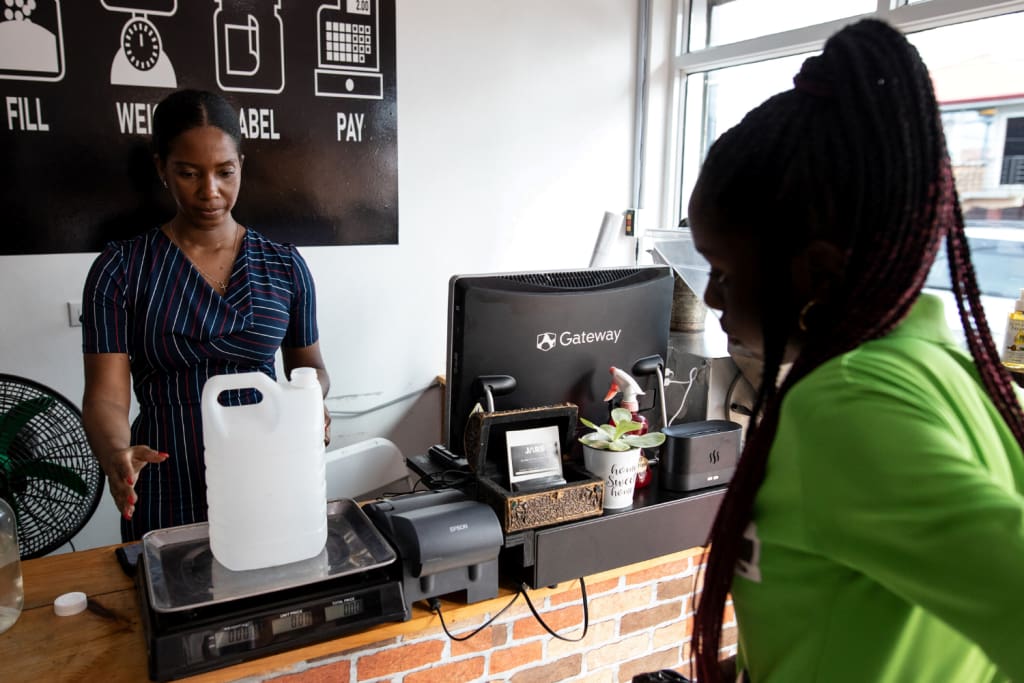
For investors, this matters for two reasons. First, it confirms that the demand-side of a circular plastics economy in Guyana is not purely hypothetical — it exists and is growing with the middle class. Second, it signals the kind of partnership opportunities available further upstream: brands committed to sustainable packaging need verified local recycled-content supply; a well-capitalised recycling facility in Guyana could supply them, turning locally collected post-consumer PET and HDPE into certified recycled resin that commands a market premium.
4. Green Link Renewable Energy — The Plastic-to-Fuel Frontier
US-based Green Link Renewable Energy entered discussions with Guyana’s government and stakeholders to develop a plastic-to-fuel conversion facility — transforming mixed waste plastics that cannot be mechanically recycled into synthetic hydrocarbon fuels through pyrolysis. While the project has moved through various stages of negotiation, its significance for investors lies in the technology pathway it represents.
Plastic-to-fuel (or plastic-to-energy) is particularly relevant in Guyana’s context because it offers a solution for the large fraction of low-grade, contaminated, or mixed plastics that conventional mechanical recycling cannot handle. In a country where waste collection infrastructure is still developing and plastics arrive at any future facility in mixed, unwashed streams, chemical recycling technologies — including pyrolysis and gasification — offer a commercially viable route to zero-landfill processing. The synthetic fuel produced can be sold into Guyana’s own energy market, or exported across the Caribbean, where energy costs remain high.
President Ali himself confirmed government openness to private proposals to convert waste to petroleum products, noting that investment decisions would be made based on investor proposals evaluated for commercial viability. The conversation is live; the partnership structure is negotiable.
The Investment Case in Plain Numbers
The macroeconomic tailwinds behind Guyana’s recycling opportunity are compelling. The country’s per-capita waste generation is forecast to rise from 0.59 kg to 0.77 kg per person per day as the economy grows — a 30% increase in the waste stream entering the system. With a population approaching 800,000 and an oil-driven economy drawing workers, international contractors, and supply chain firms from across the Caribbean and Latin America, Georgetown’s urban waste footprint will grow materially over the next decade.
At the same time, demand for recycled materials is being mandated into existence by Guyana’s key trading partners. The European Union’s revised packaging regulations require escalating minimum recycled content in plastic packaging — 30% by 2030 under the current framework. Any Guyanese exporter, and any multinational operating in Guyana, that sells into the EU market will need certified recycled content in its supply chain. A functioning, internationally certified PET or HDPE recycling facility in Georgetown would not be selling into a thin, speculative market — it would be selling into a structurally mandated demand.
The UNEP-backed Zero Waste in the Caribbean programme has identified Deposit Return Systems and Tipping Fee models as viable financing instruments for the region, meaning that future regulatory changes could deliver a guaranteed feedstock revenue stream to whoever owns the recycling infrastructure before the rules change.
What Investors Need to Know
Structure matters. The SES consortium model — international environmental technology firm plus local construction partner plus established shorebase operator — worked because each party brought something irreplaceable. Foreign investors entering the Guyanese recycling space should seek local partners not merely for political cover, but for genuine operational leverage: land access, labour networks, government relationships, and community trust.
Anchor contracts de-risk the entry. The single biggest lesson from SES is that a long-term offtake agreement — from the oil sector, from a major beverage company with EU sustainability commitments, or from the municipality itself under a tipping fee arrangement — transforms the investment risk profile from speculative infrastructure to contracted services. Foreign investors should structure entry accordingly.
The regulatory window is closing. Guyana’s Solid Waste Management Bill, once enacted, will formalise licensing requirements, impose Extended Producer Responsibility obligations on manufacturers and importers, and potentially establish minimum recycled content rules. Companies that build facilities before these rules arrive will be first in the licensing queue and positioned to shape the standards. Companies that wait will be entering a regulated market at higher cost.
Technology choice is strategic. The waste stream arriving at any Guyanese facility in the near term will be mixed, inconsistently sorted, and contaminated. Investors should plan for mechanical recycling of clean streams (PET bottles, HDPE containers) supplemented by chemical recycling or waste-to-energy for mixed fractions — not assume European-grade source-separation from day one.
Conclusion: The First Mover Advantage Is Real
Guyana’s plastic recycling sector sits at the moment that the most attractive emerging market investments always occupy: the problem is undeniable, the policy intent is visible, the population and economy are growing, the anchor clients exist, and the infrastructure does not. The only thing missing is capital with the nerve to move before the opportunity becomes obvious.
Those who entered Guyana’s oil sector in 2016, when the first exploration results came in, understood that the gap between a proven resource and functioning infrastructure is where the highest returns are made. The same logic applies here — not in barrels, but in tonnes of PET reclaimed from the Demerara River before it reaches the sea.
The garbage is not the problem. The garbage is the asset. The question is who builds the system to capture it.
This article draws on publicly available government statements, UNEP programme documentation, company disclosures, and investment research. It does not constitute financial advice.