


A Small Nation’s Giant Moment

A Small Nation’s Giant Moment
SHIELD OF THE AMERICAS · PART II
Guyana, the Shield of the Americas, and the New Geopolitics of Oil at the Edge of the World
GEORGETOWN, GUYANA | MARCH 2026
For most of its 58 years as an independent nation, Guyana occupied a curious position in the global imagination — too small to attract sustained attention, too complex to fit easy narratives, and too remote to figure seriously in the calculations of great powers. With a population smaller than metropolitan Houston scattered across a territory of dense jungle, savanna, and one narrow strip of coastal flatland, the former British colony spent generations caught between poverty, political division, and the slow hemorrhage of its best-educated citizens to New York, Toronto, and London. Then, in 2015, a drill bit hit something extraordinary in deep Atlantic waters 120 miles off the Guyanese coast. And nothing has been the same since.

On March 7, 2026, President Mohamed Irfaan Ali took his seat at the Shield of the Americas summit in Doral, Florida, among the most consequential gathering of Western Hemisphere leaders in a generation. His presence was not merely symbolic. Guyana — this country of 800,000 souls that most Americans could not locate on a map five years ago — is now the fastest-growing economy on Earth, a critical pillar of U.S. energy security, and the front line of a geopolitical contest between Washington and the remnants of a Venezuelan regime that spent the better part of a decade threatening to swallow two-thirds of its territory. The Shield of the Americas changes Guyana’s strategic calculus profoundly. What it offers is extraordinary. What it demands — and what it risks — deserves equally clear-eyed examination.
From Poverty to Petroleum Powerhouse
To understand what the Shield of the Americas means for Guyana, you first have to understand the scale of the transformation already underway. ExxonMobil’s 2015 discovery in the Stabroek Block was not a modest find. It was one of the most significant offshore oil discoveries of the 21st century — an underwater formation so vast that the IMF now ranks Guyana as the world’s seventh wealthiest country by GDP per capita, ahead of Norway and behind Qatar. A country that recorded a GDP of $4.3 billion in 2015 is projected to see that figure reach $26 billion in 2026, and $41 billion by 2030.
The production numbers are staggering for a nation of this size. By the end of 2025, Guyana was lifting roughly 900,000 barrels of oil per day — an almost tenfold increase from 2020. With ExxonMobil’s Uaru and Whiptail projects coming online through 2026 and 2027, output is projected to exceed 1.3 million barrels per day, with a longer-term target approaching 1.8 million. The IMF has tracked average real GDP growth of 47 percent per year since 2022 — a figure so extraordinary that economists treat it as almost without modern parallel. Petroleum revenues now account for more than a third of the national budget, with oil income estimated at $2.5 billion in 2025 alone and projected to exceed $3 billion in 2026.
Related Posts:
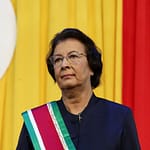


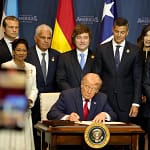




The IMF now ranks Guyana as the world’s seventh wealthiest country by GDP per capita — ahead of Norway, behind Qatar. A decade ago, it was one of the poorest nations in the hemisphere.
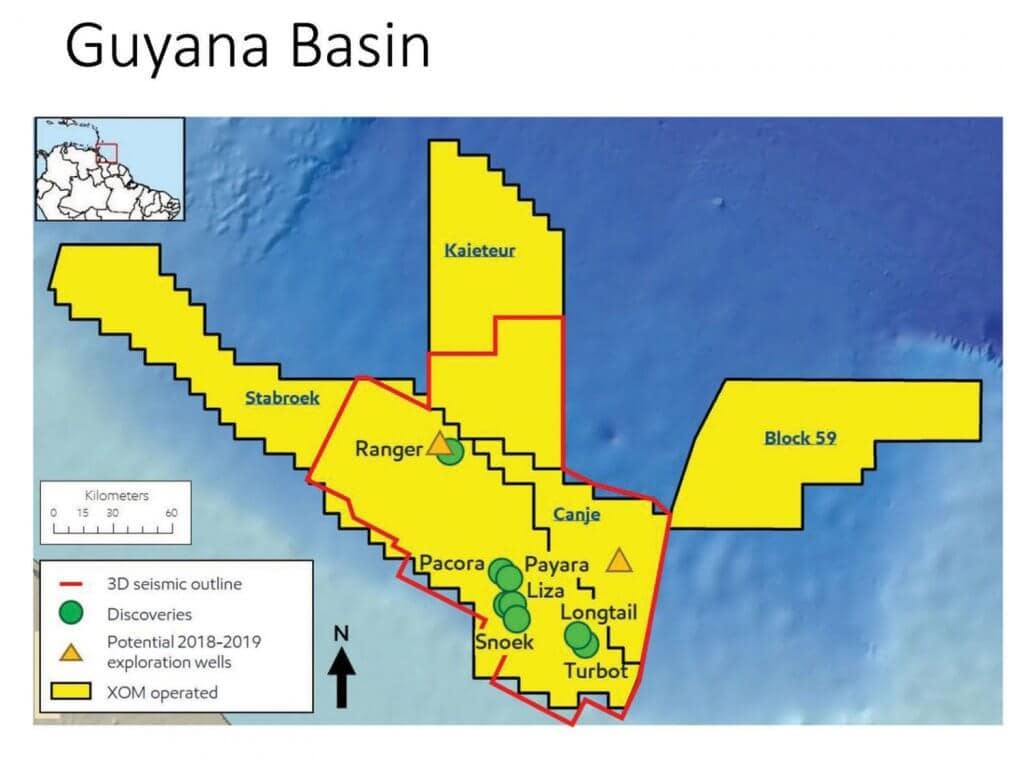
The consortium operating the Stabroek Block is itself a microcosm of the geopolitical forces now converging on Guyana. ExxonMobil, the American operator, holds a 45 percent stake. Chevron — which completed its acquisition of Hess Corporation in 2024 after a protracted arbitration battle — controls 30 percent. The remaining 25 percent is held by CNOOC, China’s largest state-owned offshore oil producer. The presence of China’s national oil company in Guyana’s most critical asset means that the contest between Washington and Beijing for influence in the Western Hemisphere is not merely an abstract geopolitical argument. It is playing out, barrel by barrel, in the Atlantic waters off Georgetown.
The Dragon at the Door: Venezuela’s Essequibo Gambit
The territory that Venezuela calls ‘Guayana Esequiba’ and Guyana calls simply its own comprises 61,600 square miles of dense Amazon jungle — nearly two-thirds of Guyana’s national territory, one-sixth of its population, and, critically, the continental shelf beneath which the Stabroek Block sits. For over a century, the dispute was largely theoretical. Then ExxonMobil struck oil beneath those contested waters, and Nicolás Maduro transformed a historical grievance into an active instrument of political survival.
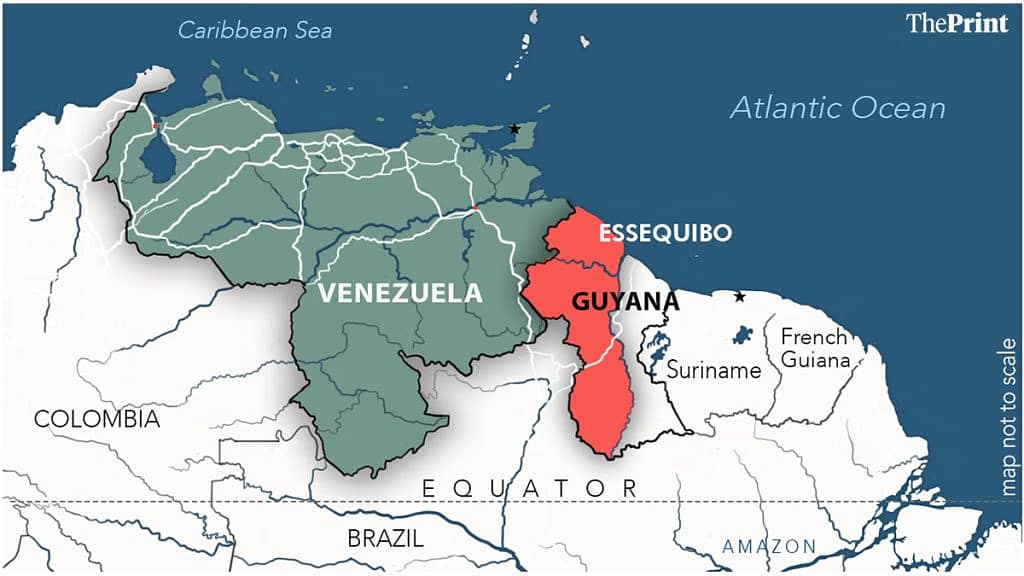
The escalation followed a relentless logic. In 2021, Maduro vowed to ‘reconquer’ Essequibo and unilaterally declared it a Venezuelan strategic development zone. In December 2023, he organized a referendum — widely condemned as fraudulent — in which Venezuelans reportedly voted to make Essequibo a Venezuelan state. In April 2024, he signed that result into law, ignoring a binding International Court of Justice order prohibiting unilateral changes to the territory’s status. In May 2025, Venezuela included Essequibo in its provincial elections, swearing in a governor for what it called its newest state. All while the ICJ — whose jurisdiction Venezuela flatly refuses to accept — prepares a ruling expected in August 2026.
On March 1, 2025, Venezuela’s navy made its most direct move yet, intercepting vessels in Guyana’s exclusive economic zone in what CSIS analysts described as ‘a significant escalation of Venezuela’s intimidation and harassment of Guyana’s oil exploration.’ Six soldiers of the Guyana Defence Force were wounded in a border shootout with Venezuelan gang members. Satellite imagery, declassified and published by U.S. intelligence analysts, showed Venezuelan troops and naval assets massing on Anacoco Island — a piece of Essequibo that Venezuelan forces had occupied since 1966 — and a military base expanding its footprint by measurable degrees each month.
The Venezuelan military is numerically overwhelming compared to Guyana’s. Defense analysts have noted that Venezuela’s armed forces, though degraded by years of corruption and deliberate fragmentation under Maduro, would still represent an existential threat to a country with no air force to speak of and an army smaller than many Latin American police forces. Guyana’s jungle geography — dense, roadless, nearly impassable — provides some natural defense, but it has not prevented incursions. For Guyanese, the threat was never abstract. It was a lived reality, encoded in national consciousness, and inflamed every time Maduro spoke in front of a map that showed Essequibo colored Venezuelan green.
The January Earthquake: Maduro’s Capture and Its Aftermath
The geopolitical landscape shifted violently on January 3, 2026, when U.S. special operations forces conducted a night raid on Venezuelan soil, capturing Nicolás Maduro and his wife Cilia Flores and transferring them to a federal detention facility in New York to face charges of narco-terrorism and crimes against humanity. The operation — condemned by Brazil, Mexico, Colombia, and much of the global south as a flagrant violation of international law — took 18 minutes from insertion to extraction. For Guyana, the reaction was more complicated.
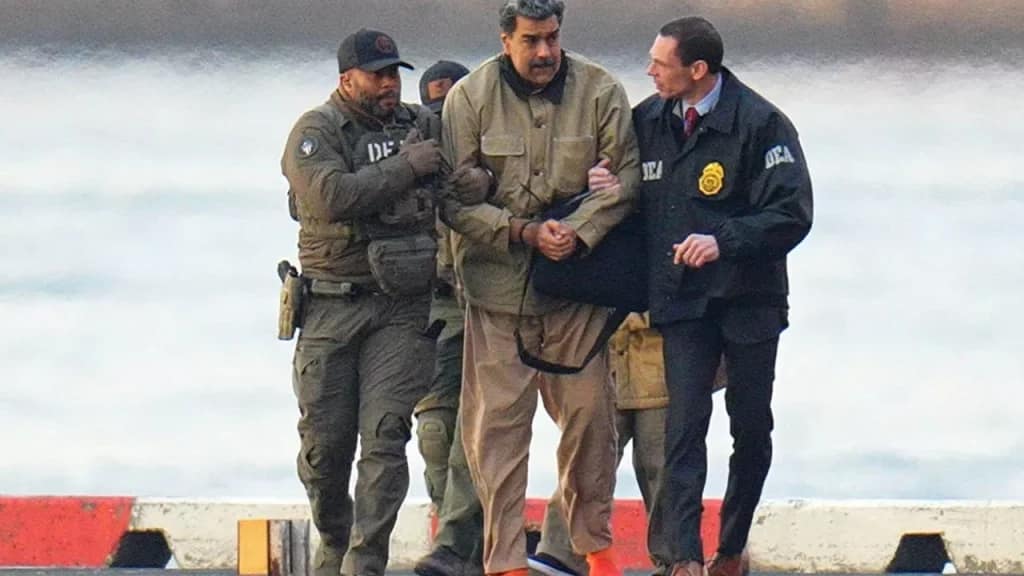
In Georgetown, the response was not celebration, but careful, cautious relief. The official position of the Ali government was measured — expressing respect for legal process and reaffirming commitment to the ICJ’s authority over the Essequibo dispute while pointedly declining to join CARICOM and South American neighbors in condemning Washington’s action. In private, the relief was reportedly less restrained. Maduro had been, as one Guyanese commentator put it bluntly, ‘not just a problem for his own country, but for Guyana and the region as a whole.’ His removal, however legally contested, removed the most immediate military threat to Guyana’s territorial integrity.
‘Now, with the U.S.’s intent to control the country, any action by Venezuela becomes even more remote — removing a nuisance for Exxon and Guyana.’ — Allen Good, Director of Equity Research, Morningstar
Financial markets responded immediately. Morningstar’s Allen Good noted that ExxonMobil’s Guyana operations had always been shadowed by the Essequibo threat, and that Washington’s direct intervention in Venezuela had effectively neutralized what had been the principal geopolitical risk to the world’s most valuable new deepwater oil province. Investors who had required an Essequibo-risk premium on Guyanese assets began recalibrating. Analysts at OilPrice.com declared flatly that ‘Maduro’s capture secured the future of Guyana’s oil boom.’ The judgment may prove premature — Venezuela’s government remains in place, the territorial claim has not been formally abandoned, and the ICJ ruling is still outstanding — but the immediate strategic relief was real.
What the Shield Offers: Five Concrete Opportunities
President Ali’s seat at the Doral summit was not merely symbolic hospitality from a powerful patron. It represented the formalization of a security relationship that carries potentially transformative implications for a small country navigating an extraordinarily dangerous moment in its history. The Shield of the Americas offers Guyana at least five concrete strategic opportunities.
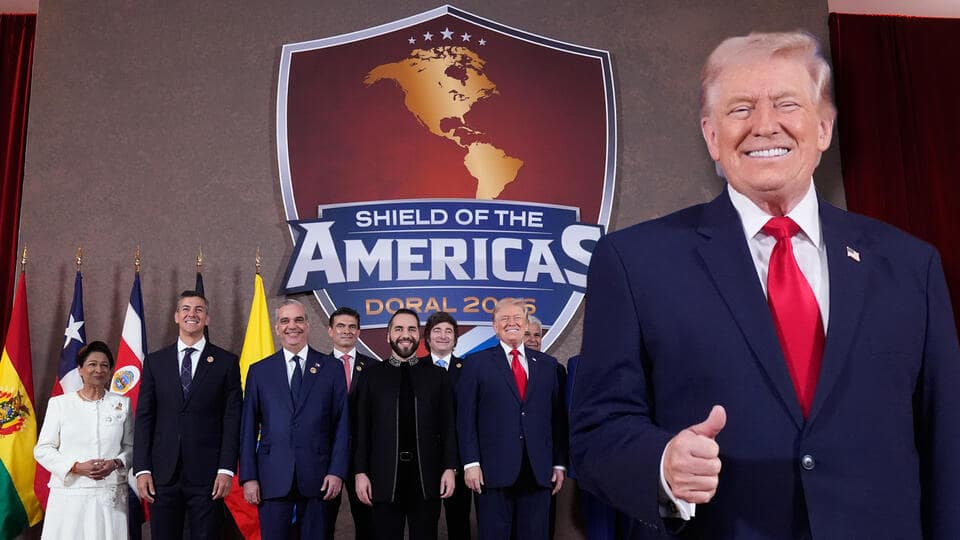
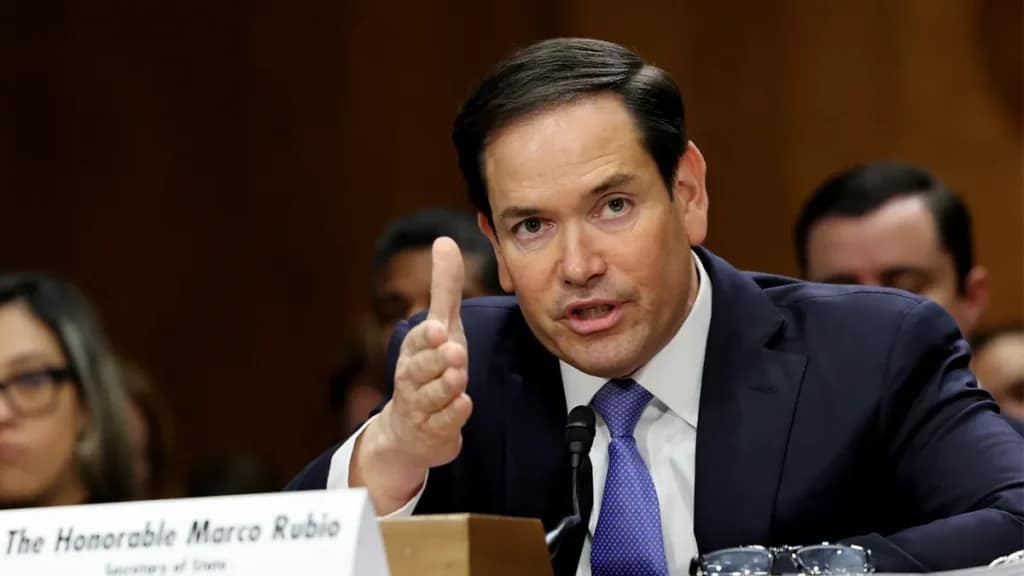
First, and most immediately, a credible military deterrent against Venezuelan aggression that Georgetown could never construct on its own. Under the Shield framework, U.S. intelligence-sharing, maritime surveillance, and the implicit guarantee of American military response to any Venezuelan move against Guyanese oil assets dramatically alters the risk calculus in Caracas. Rubio’s visit to Georgetown in March 2025 — where he warned that any attack on Guyana would be a ‘very bad day’ for Venezuela — was the clearest articulation yet of a commitment that the Doral summit has now institutionalized. For a country whose air force consists of roughly a dozen light aircraft, the value of this guarantee is incalculable.
Second, the coalition’s explicit focus on counter-cartel operations addresses Guyana’s fast-deteriorating internal security situation. The Essequibo region has become, in the words of InSight Crime, ‘fertile ground for organized crime,’ with Venezuelan criminal networks expanding illicit gold mining, drug trafficking, and human smuggling through the porous jungle border. Guyana’s state presence in Essequibo is thin — underfunded border posts, limited road access, almost no law enforcement capacity in the deep interior. The Shield’s intelligence-sharing architecture and potential for joint operations with better-equipped U.S. and regional partners could help Georgetown address criminal infiltration that threatens to destabilize the very territory it is trying to defend.
Third, the summit’s explicit counter-China dimension offers Guyana a potential renegotiation of its relationship with CNOOC. China’s 25 percent stake in the Stabroek Block gives Beijing a significant foothold in U.S. energy security calculations — a fact Washington is acutely aware of. Under Shield of the Americas logic, the Trump administration has strong incentives to encourage — or pressure — an arrangement that reduces Chinese exposure in Guyanese energy. For Georgetown, this creates rare leverage: the ability to extract concessions, infrastructure investment, or preferential trade terms from Washington in exchange for cooperation on limiting Beijing’s footprint.
Fourth, the coalition offers economic diversification opportunities beyond oil. The Shield’s framework of expanded U.S. development finance, technology partnerships, and supply chain integration could help Guyana address the sovereign risk that threatens every petro-state: commodity dependence. Guyana’s sovereign wealth fund has been growing, and the government has publicly committed to investing oil revenues in agriculture, infrastructure, and human capital. American institutional backing — through EXIM Bank, the DFC, and bilateral trade agreements — could help accelerate that diversification before the inevitable day when oil prices fall or production plateaus.
Fifth, and perhaps most consequentially, the Shield of the Americas gives Guyana something that has historically been in short supply for small nations: a voice at tables that matter. President Ali can now pick up the phone and reach Kristi Noem directly. His government has direct access to the secretaries of state, defense, and treasury of the most powerful country on earth. For a nation that spent decades watching decisions affecting its future made in Caracas, London, or Washington without its input, that access represents a qualitative shift in diplomatic standing.
The Costs of the Shield: Navigating Dangerous Waters
No strategic realignment comes without cost, and Guyana’s leadership would be naive to treat the Shield of the Americas as an uncomplicated gift. The risks are real, and in some cases, the very forces that make the coalition attractive also make it dangerous.
The most immediate concern is CARICOM solidarity. Guyana is a member of the Caribbean Community, a 15-nation regional bloc that has historically maintained a cautious, consensus-based approach to hemispheric politics. The majority of CARICOM states condemned the U.S. military intervention in Venezuela. Several — including Trinidad and Tobago, which also attended Doral — are walking a delicate line between Washington’s new assertiveness and their own populations’ instinctive skepticism of great-power unilateralism. Georgetown’s visibly close embrace of the Trump administration risks fracturing relationships with neighbors who share the same Caribbean Sea and many of the same developmental challenges. Guyana’s oil wealth already generates resentment in the region; its role as Washington’s most prominent Caribbean ally could deepen that isolation.
Second, the Essequibo dispute has not been resolved — only suppressed. Venezuela’s government remains in place under new leadership, the territorial claim remains enshrined in Venezuelan law and national consciousness, and the ICJ ruling expected in August 2026 will not automatically bind a government that has already declared the court’s jurisdiction illegitimate. A post-Maduro Venezuela that feels humiliated by American intervention and stripped of its political leader could, under certain scenarios, pursue the Essequibo claim with renewed nationalist fury. Georgetown’s security depends not just on American deterrence, but on a durable political settlement — and that settlement requires diplomacy with Caracas that the current atmosphere makes extraordinarily difficult.
Third, the domestic politics of oil are growing complicated in ways that the Shield’s security umbrella cannot resolve. Despite its extraordinary GDP growth, approximately 58 percent of Guyana’s population remains in poverty by the Inter-American Development Bank’s estimates. The oil wealth has primarily benefited a relatively narrow stratum of politically connected elites, contractors, and financial intermediaries. President Ali’s PPP/C government faces a legitimate domestic challenge: translating macroeconomic statistics into lived improvements for the Amerindian communities of the interior, the sugar workers of the coastal plains, and the urban poor of Georgetown’s flooded streets. A security coalition with Washington can protect Guyana’s oil fields. It cannot, by itself, distribute their proceeds justly.
Guyana’s fate is now tied to external power dynamics. Both Caracas and Washington view the country through a wider lens — and in that lens, Guyana is always the object, rarely the subject, of history.
Fourth, there is the uncomfortable question of what Washington’s protection requires in return. The Trump administration’s Shield of the Americas is explicitly transactional. Countries that want access to American military guarantees are expected to demonstrate alignment on migration enforcement, counter-narcotics operations, and — increasingly — Chinese economic exclusion. For Guyana, the CNOOC stake in Stabroek is an immediate test case. If Washington demands that Georgetown take steps to dilute or eliminate Chinese participation in its most valuable economic asset, the government faces a painful choice: risk the production disruption and Chinese retaliation that could follow, or push back against the patron whose military deterrence is keeping Venezuelan ambitions at bay.
The Bigger Picture: A Small Country at History’s Hinge
There is a temptation, in assessing Guyana’s position, to see the country purely as a passive object of great-power competition — a small nation buffeted by forces it cannot control, fortunate to have found oil beneath its waters before the geopolitical storm arrived. That view understates both the agency of Guyanese leadership and the genuine complexity of the choices before it.
President Ali has shown, across a turbulent several years, a capacity for pragmatic navigation that belies the stereotype of the small-state leader as a supplicant. He held firm against Venezuelan military intimidation when other Caribbean governments urged accommodation. He welcomed Rubio’s visit in March 2025 and extracted from it a public American commitment to Guyana’s territorial integrity. He attended Doral not as a client but as a sovereign — one with an economy growing faster than any other on earth, oil reserves larger than Norway’s, and a geographic position that makes it indispensable to any serious U.S. strategy in the Caribbean basin.
The Shield of the Americas, for Guyana, is not a rescue. It is a rebalancing. For decades, Guyana’s weakness was the dominant fact of its external relations — it could be threatened by Venezuela, ignored by Washington, and exploited by foreign oil companies on terms that the government of a stronger nation would never have accepted. The 2016 Production Sharing Agreement with ExxonMobil, under which Guyana receives a 2 percent royalty and 12.5 percent profit share, has been widely criticized by economists as unusually favorable to the operator, a reflection of the desperate eagerness of a poor country willing to take almost any deal to get the oil flowing. Renegotiating that agreement — or at least ensuring that future contracts reflect Guyana’s new leverage — is a long-term priority that U.S. backing makes slightly more achievable.
The ICJ ruling expected in August 2026 looms over everything. If the court rules definitively in Guyana’s favor — as the weight of international legal opinion suggests it will — and if the post-Maduro Venezuelan government can be brought to accept that ruling, the Essequibo dispute could theoretically transition from an active threat to a manageable historical grievance. That transition, however, requires more than an American security umbrella. It requires the construction of a new bilateral relationship with whatever government emerges in Caracas — a relationship premised not on the fear of annexation, but on the possibility of economic cooperation in a region where the complementary oil and gas endowments of both countries could, in a different political universe, form the foundation of genuine shared prosperity.
That is, admittedly, a vision for a different era. In the immediate term, Guyana’s strategic imperatives are clear: secure the American guarantee, build the domestic institutions capable of managing sudden wealth without succumbing to the resource curse, deepen relationships within CARICOM while not sacrificing the U.S. alignment that makes territorial integrity credible, and press forward on the ICJ process that offers the only durable legal resolution to the dispute that has haunted the country’s existence since before independence.
A nation that produced 900,000 barrels of oil per day in 2025 from waters that were empty of infrastructure a decade earlier has already demonstrated an extraordinary capacity to reshape its own destiny. The Shield of the Americas offers Guyana a chance to make that reshaping permanent — to transform a transient oil boom into a durable strategic position at the center of hemispheric security. Whether it seizes that chance, or is consumed by it, may be the defining question of the Ali era — and of Guyana’s first century as a sovereign nation.
— ◆ —
March 11, 2026