


The Reluctant Neighbor

Suriname, the Shield of the Americas, and the Impossible Balancing Act of Jennifer Geerlings-Simons
SHIELD OF THE AMERICAS · PART III
PARAMARIBO, SURINAME | MARCH 2026
The delegation from Suriname arrived in Doral, Florida, as every delegation does at multilateral summits — quietly, with protocol officials rather than presidents, and with carefully worded instructions not to commit to anything that could not be walked back in Paramaribo. Jennifer Geerlings-Simons, the 71-year-old physician-turned-president who had been in office exactly eight months, sent representatives. She did not come herself. The choice was deliberate, and everything about it was a message.
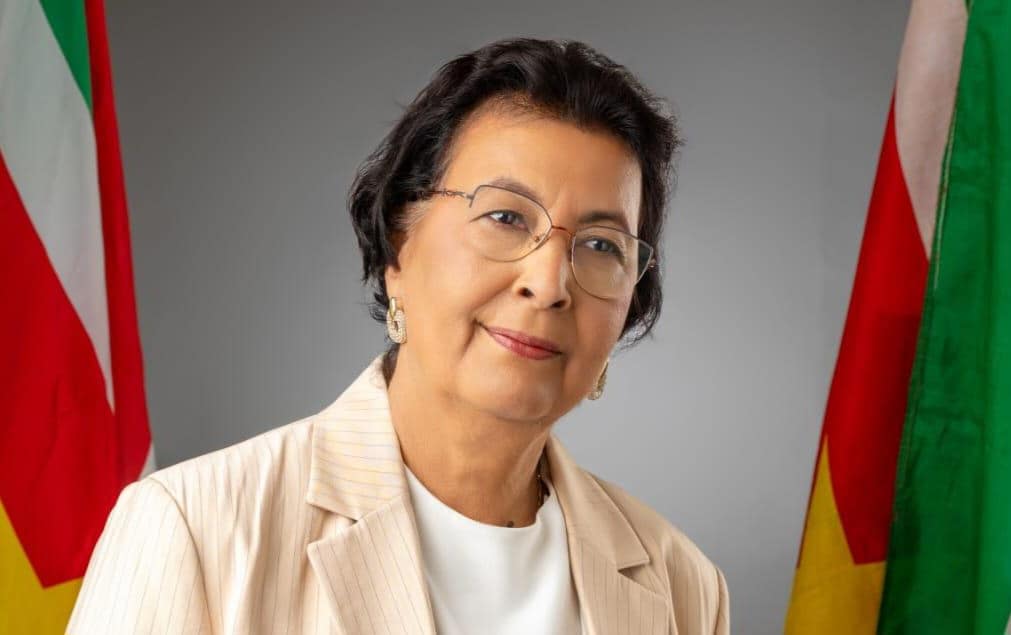
On one side of the room in that Doral ballroom sat the conservative leaders of the Americas — men like Javier Milei, Nayib Bukele, and Ecuador’s Daniel Noboa — who had made their alignment with Donald Trump’s hemispheric vision not just a security posture but an ideological identity. On the other side of the Atlantic, metaphorically speaking, sat a government in Paramaribo that had spent its first months in power signaling, with increasing clarity, that it would not be joining that club — at least not on Washington’s terms.
Suriname’s position heading into the Shield of the Americas era is arguably the most conflicted of any small nation in the hemisphere. It is a country that desperately needs everything the coalition promises — security partnerships, investment, economic stability, an end to the narco-trafficking that has haunted its politics for decades — yet is governed by a president whose party, whose history, and whose diplomatic instincts pull sharply in a different direction. Understanding what the Shield of the Americas means for Suriname requires understanding, first, why Geerlings-Simons is not yet ready to embrace it.
The Ghost at the Banquet: Bouterse’s Long Shadow
To understand Jennifer Geerlings-Simons, you must first understand the party she inherited. The National Democratic Party of Suriname was founded in 1987 by Desiré Bouterse — a military sergeant who had seized power in a coup in 1980, governed the country as a strongman through the decade that followed, ordered the execution of fifteen political opponents in a single night in December 1982, and was eventually convicted of drug trafficking in the Netherlands and of murder in his own country’s courts. He died in December 2024, still a fugitive, having refused to report to prison to serve his twenty-year sentence. He was seventy-nine years old.
Related Posts:





Geerlings-Simons had served as chairwoman of the National Assembly under Bouterse’s presidency from 2010 to 2020. She is, by any measure, a figure of the NDP establishment — educated, composed, and deeply embedded in the political network that Bouterse spent four decades constructing. When she took over the party leadership after his death and led it to its first-place plurality in the May 2025 elections, she did so by presenting herself as the civilian face of an organization with a deeply uncivilized history — one that the U.S. State Department’s own congressional research service described as formerly running a country that functioned, under Bouterse, as a narco-state in which ‘some senior government officials may be engaged in corruption and narcotics trafficking.’
This is not ancient history. The DEA maintained an active office in Suriname from 2006 until 2016, when it was forced to withdraw after arresting Dino Bouterse — the former president’s son — in Panama for drug trafficking and, more alarmingly, for attempting to help Hezbollah establish a base in Suriname. In October 2024, just months before Geerlings-Simons took office, the DEA and Suriname’s attorney general quietly signed a new memorandum of understanding on counternarcotics cooperation — a sign that Washington was willing to reset the relationship, but also a reminder of how deeply it had deteriorated.
Washington congratulated Geerlings-Simons on her election while noting, almost in the same breath, its desire to see Suriname ‘limit CCP influence.’ The message was warm. The agenda was unmistakable.
The U.S. State Department’s congratulatory statement on her election was carefully worded. It praised Suriname’s ‘transparent business practices’ and ‘democratic institutions,’ and then added, pointedly, that Washington ‘encourages continued U.S. private sector engagement’ and ‘supports Suriname’s efforts to foster economic growth and diversify its economy, and limit CCP influence.’ The warmth and the warning arrived in the same paragraph.
Sovereignty and the Maduro Question
Geerlings-Simons’ skepticism about the Shield of the Americas was crystallized, in the eyes of Washington observers, by her government’s response to the January 2026 capture of Nicolás Maduro by U.S. special forces. While Guyana’s Ali government carefully avoided condemning the operation, and while the conservative governments at Doral treated Maduro’s removal as a cause for quiet satisfaction, Paramaribo’s reaction was sharper.
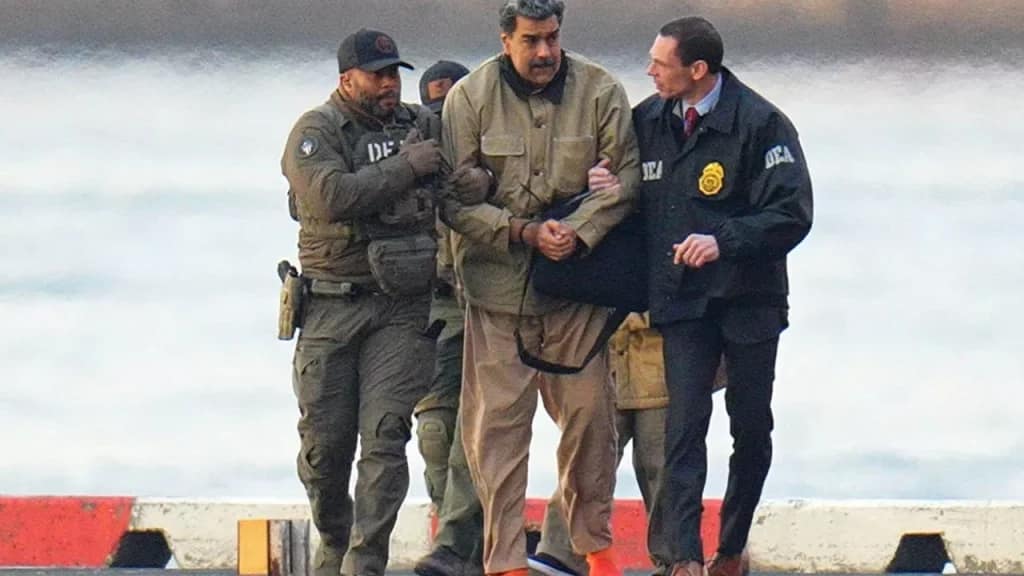
Suriname joined a chorus of regional voices — alongside Lula’s Brazil and Sheinbaum’s Mexico — in expressing concern about what it characterized as a violation of Venezuelan sovereignty and a dangerous precedent for the use of military force in the region without legal authorization. Geerlings-Simons, speaking to the Surinamese press, was candid about her discomfort, describing the operation as ‘disrespecting sovereignty’ and arguing that, however one viewed Maduro’s conduct, the unilateral military extraction of a sitting head of state from his own territory represented a line that should not have been crossed.
The position was principled. It was also politically complicated. Suriname shares a 600-kilometer jungle border with Brazil, and its most natural regional alignments — historically, culturally, and economically — pull toward Paramaribo’s Portuguese-speaking southern neighbor rather than toward the Anglo-Caribbean world or the Spanish-speaking right that has coalesced around Trump. The NDP’s political ideology, such as it is, tilts center-left, toward economic nationalism and social spending. Geerlings-Simons’ coalition includes Ronnie Brunswijk’s ABOP party — the vice president’s political vehicle — and Brunswijk himself was convicted in absentia in the Netherlands on drug trafficking charges in 1999. The vice president of Suriname cannot easily travel to the Netherlands or France without risk of arrest.
This is the company Geerlings-Simons keeps, and it is why Washington’s relationship with her government will be transactional rather than ideological — a careful negotiation between shared interests and fundamental mistrust, rather than the warm alliance of shared political vision that characterizes U.S. relationships with Milei’s Argentina or Bukele’s El Salvador.
The Cocaine Highway That Runs Through Paramaribo
Whatever the diplomatic nuances of Suriname’s position, the operational reality of its role in the Western Hemisphere’s narcotics trade is not in dispute. The U.S. State Department’s International Narcotics Control Strategy Report identifies Suriname as a major cocaine transit country — a nation through which South American cocaine, primarily from Colombia and Venezuela, flows toward Europe, West Africa, and to a lesser extent the United States. The routes are well-established and have barely changed in three decades.

Cocaine arrives in Suriname primarily by private aircraft from Colombia and Venezuela, landing on clandestine airstrips in the dense, roadless interior — strips that are almost impossible to monitor given Suriname’s vast, underpopulated jungle geography. It is then concealed in shipping containers at the port of Paramaribo, loaded onto cargo vessels, and routed through French Guiana, Martinique, and the Netherlands. A CSIS analysis of transatlantic drug flows estimated that between 15 and 20 percent of all cocaine reaching France comes through this corridor. Smaller quantities move by narco-submarine, transferring cargo to large freight vessels in international waters off Suriname’s Atlantic coast.

What makes Suriname’s trafficking problem especially intractable is the degree to which it has historically been intertwined with political power. The Bouterse era left a legacy of normalized narco-corruption that extends deep into law enforcement, customs, the judiciary, and the financial system. A U.S. State Department report noted with characteristic diplomatic understatement that ‘some senior government officials may be engaged in corruption and narcotics trafficking.’ Local criminal networks in Suriname collaborate with Colombian, Brazilian, and Venezuelan organizations, and intelligence reports have flagged Chinese criminal networks as increasingly active in the country’s money-laundering ecosystem, particularly through the casino industry and gold trading.
The illicit gold sector adds another layer of complexity. Suriname’s interior is home to tens of thousands of informal and illegal gold miners — garimpeiros, as the Brazilian term goes — operating in areas far beyond any effective government oversight. These operations use mercury, poison waterways, displace indigenous communities, and provide ready infrastructure for drug trafficking: remote airstrips, river routes, and cash-intensive economies that make money laundering straightforward. The Shield of the Americas’ counter-cartel focus, if extended to Suriname, would inevitably mean pressure to shut down or formalize the gold sector — a politically explosive proposition in a country where artisanal mining represents a significant share of low-income employment.
Cocaine from Colombia and Venezuela transits Suriname’s jungle airstrips and container ports on its way to Europe. Between 15 and 20 percent of all cocaine reaching France passes through this corridor.
The Oil Promise: Suriname’s Parallel Guyana
If Suriname’s security and political situation is defined by complexity and contradiction, its economic future is defined by something far more straightforward: oil. In 2020, TotalEnergies and APA Corporation discovered significant hydrocarbon deposits in offshore Block 58, a deepwater block that lies directly adjacent to Guyana’s prolific Stabroek Block — the same formation that made Georgetown the fastest-growing economy on Earth. In October 2024, TotalEnergies approved the Final Investment Decision for the GranMorgu project, committing $10.5 billion to develop the Sapakara and Krabdagu fields, which contain estimated recoverable reserves of 750 million barrels.

The numbers are transformative, if more modest than Guyana’s. GranMorgu, which will use an all-electric floating production, storage, and offloading vessel 150 kilometers off Suriname’s coast, is targeted for first oil in 2028, with a peak production capacity of 220,000 barrels per day. The IMF projects that Suriname’s GDP will grow by a stunning 55 percent in the year production begins. In a country of 646,000 people carrying $400 million in annual debt servicing that it currently cannot cover, $10.5 billion of capital investment and the prospect of hundreds of millions in annual oil revenues is not just an economic event — it is an existential one.
Unlike Guyana’s Stabroek Block, which is dominated by American and Chinese capital, the consortium developing Suriname’s offshore is primarily European and American: TotalEnergies of France is the operator of Block 58 with a 50 percent stake, with APA Corporation of the United States holding the other 50 percent. In Block 53, TotalEnergies holds 25 percent, with APA as operator at 45 percent and Malaysia’s Petronas at 30 percent. There is no Chinese national oil company in Suriname’s offshore consortium — a fact that makes Paramaribo’s oil geography significantly more comfortable for Washington than Georgetown’s, and one that removes the CNOOC pressure point that complicates U.S. engagement with Guyana.
However, Suriname’s broader economic relationship with China runs deep in other ways. In 2019, under the Bouterse government, Suriname became one of the first Latin American countries to formally join China’s Belt and Road Initiative. Chinese capital flows into Suriname’s infrastructure, timber, and mining sectors. Chinese goods dominate the informal economy of Paramaribo’s markets. Chinese criminal networks — flagged by U.S. intelligence reports — are embedded in the country’s gold and gambling industries. Washington’s demand, implicit in the Shield of the Americas framework, that partner nations ‘limit CCP influence’ is, for Suriname, not a simple matter of declining a contract. It is a demand to unravel a web of economic relationships that, for many Surinamese, are the only working alternative to an economy that has failed them repeatedly.
What the Shield Offers — and What It Costs
The strategic calculus facing Geerlings-Simons is, in its essentials, a version of the same dilemma facing every small nation in the Shield of the Americas era: the coalition offers real benefits, but extracting them requires accepting constraints that challenge sovereign autonomy. For Suriname, the benefits are especially urgent and the constraints especially uncomfortable.
On the benefit side, Suriname needs security assistance that it cannot generate itself. Its police force is under-resourced, corruption-riddled, and has historically lacked the political will — given the NDP’s own narco-trafficking entanglements — to pursue major trafficking networks seriously. A restored DEA presence, enhanced intelligence-sharing, and maritime interdiction partnerships could substantially improve Suriname’s ability to manage the trafficking routes that have made it an international embarrassment and a Washington watchlist fixture for three decades. With the GranMorgu project coming online in 2028 and deepwater infrastructure worth tens of billions of dollars appearing off its coast, Suriname’s security needs are about to escalate dramatically. Offshore oil platforms are terrorism and piracy targets. Suriname’s tiny navy is not equipped to defend them.
The Shield framework also offers Suriname a path to the development finance and trade relationships that can help bridge the desperately difficult years between now and 2028, when GranMorgu’s revenues begin flowing. The IMF has stabilized Suriname’s macroeconomic situation, but the country still faces crushing debt servicing, a population angry about years of austerity, and a government with limited fiscal space to make good on its social spending promises. U.S. Development Finance Corporation investment, EXIM Bank support, and the commercial relationships that follow from demonstrated alignment with Washington could all help Paramaribo finance the infrastructure — ports, roads, skilled workforce training — that it needs before the oil era arrives.
On the cost side, full Shield of the Americas participation would require Geerlings-Simons to take positions — on Maduro’s capture, on Chinese economic exclusion, on joint counter-narcotics operations that could implicate politically connected individuals — that her coalition cannot currently sustain. Brunswijk’s ABOP party, which supplies the vice president and holds critical coalition seats, has its own trafficking history and little appetite for the kind of deep institutional anticorruption reforms that genuine security partnership with Washington demands. The NDP’s left-wing nationalist base sees Washington’s hemispheric assertiveness as a threat to be managed, not an opportunity to be seized.
There is also the matter of the Dutch connection. Suriname retains deep economic and linguistic ties to the Netherlands — the former colonial power that still processes a large share of Suriname’s cocaine exports through Rotterdam, that funds development programs in Paramaribo, and that maintains a diplomatic relationship that gives the Geerlings-Simons government a credible alternative to exclusive dependence on Washington. The Shield of the Americas is explicitly structured as a bilateral U.S. initiative rather than a multilateral European one. The more Paramaribo is seen as a Washington client, the more complicated its relationship with The Hague becomes.
The Narrow Path: Between Washington and Paramaribo
There is, nonetheless, a path available to Geerlings-Simons that is neither full embrace nor outright rejection of the Shield of the Americas — and it is a path that, given her pragmatic background as a physician and public health administrator, she may be temperamentally suited to walk.
The model, if there is one, might be found not in the conservative governments of the coalition’s inner circle, but in the behavior of Guyana’s Ali — a leader who managed to secure American military and diplomatic backing while maintaining visible independence, who attended Doral as a sovereign rather than a supplicant, and who has so far avoided the kinds of public ideological alignment that would make him domestically toxic in a CARICOM context. Suriname does not have Guyana’s oil production yet, and therefore does not have the same leverage. But it has something valuable of its own: it is a country whose oil sector is dominated by Western capital, whose narcotics problem Washington genuinely wants solved, and whose Belt and Road membership gives it a China card it can play quietly in conversations with the U.S.
The practical steps available to Geerlings-Simons are concrete. Restoring the DEA presence to full operational capacity — which lapsed under Bouterse — signals institutional good faith without requiring public ideological commitment. Activating the October 2024 DEA-attorney general memorandum of understanding and producing visible prosecutions of trafficking networks would demonstrate that Suriname is a serious counter-narcotics partner, not just a willing cosignatory of joint declarations. Pressing forward on the formalization of the gold mining sector — a painful but economically rational reform that reduces the infrastructure available to traffickers — would address one of Washington’s deepest concerns about the country’s interior. And engaging TotalEnergies and APA Corporation as institutional allies in the case for American development finance, rather than approaching Washington directly on political terms, gives Geerlings-Simons a pathway to U.S. investment that goes through the commercial relationships already established rather than through the ideological alignment she cannot currently offer.
None of this resolves the fundamental tension between a government with an NDP heritage and the demands of a security coalition built explicitly on conservative ideological alignment. The Shield of the Americas is, by design, a club for the hemisphere’s right — and Geerlings-Simons leads a center-left coalition that includes a vice president with an Interpol file. Full membership, in the Bukele or Milei mode, is not available to her. Partial, transactional, quietly cooperative engagement with Washington on the issues that matter most — oil security, counter-narcotics, Chinese investment reduction — is.
The country Geerlings-Simons leads is, in the end, a microcosm of the dilemma that the Shield of the Americas poses for the hemisphere’s middle ground: small, vulnerable, economically desperate, institutionally fragile, and navigating a transition from poverty to petroleum wealth that will remake its society and its geopolitical position whether its government manages the process well or not. The oil will arrive in 2028 regardless of what happens in Doral. The question is whether, when it does, Suriname will have the security architecture, the institutional capacity, and the international partnerships to ensure that the wealth flowing from Block 58 reaches the Surinamese people — rather than flowing, as so much has flowed before, through the same jungle corridors and container ports and shell companies that have made this small, beautiful, troubled country a transit zone for other people’s narcotics and other people’s ambitions for as long as anyone can remember.
— ◆ —