


The Heir and the Jailhouse

How Flávio Bolsonaro, a Trump Adviser’s Prison Visit, and the Iron Logic of the Shield of the Americas Are Converging on Brazil’s October Election — and Why a Bolsonaro Victory Could, Paradoxically, Restore the Sovereignty Lula Is Fighting to Protect
SHIELD OF THE AMERICAS · PART V — CLOSING THE CIRCLE
BRASÍLIA — JERUSALEM — WASHINGTON | MARCH 2026
On the morning of March 18, 2026, a man named Darren Beattie will walk through the gates of the Federal Police headquarters in Brasília, submit an interpreter’s credentials, and spend two hours in conversation with a 70-year-old prisoner who cannot speak his language. The meeting has been authorized, after an initial skirmish over scheduling, by the very Supreme Court justice who sentenced that prisoner to 27 years in jail. The prisoner is Jair Bolsonaro. The visitor is a senior adviser to the President of the United States, appointed the previous month to a position that the Trump administration describes, with unusual specificity, as shaping U.S. policy toward Brazil. The fact that this meeting is happening at all — that the man who serves as Washington’s designated Brazil handler is visiting the country’s most famous inmate in his cell, the week after a summit that excluded Brazil’s sitting president — tells you almost everything you need to know about the moment Brazil is in.
It is a moment that is, simultaneously, a geopolitical crisis, a domestic political earthquake, and a narrative so clean it almost seems engineered. The Shield of the Americas has left Lula on the outside of the hemisphere’s new security architecture. The pending Foreign Terrorist Organization designation threatens to strangle Brazil’s banking sector and invite extraterritorial American legal action against its most powerful criminal organizations. The October elections approach with a Bolsonaro on the ballot who is, for the first time, genuinely competitive. And the world’s most powerful democracy has dispatched an adviser to sit across a table from a convicted coup plotter and, at a minimum, demonstrate that the connection between Washington and the Bolsonaro family remains warm, alive, and consequential.
The question hanging over all of it is the one that the Lula government finds most uncomfortable to articulate, because articulating it means conceding the terrain on which the battle is being fought: Is it possible that the only path back to genuine Brazilian sovereignty — freedom from American pressure, withdrawal of the FTO designation threat, re-entry into the hemispheric security conversation on equal terms — runs through the election of Flávio Bolsonaro?
The Man from Trump’s Orbit: Who Is Darren Beattie?
Understanding the significance of the Beattie visit requires understanding who Beattie is — and who he is not. He is not a career diplomat. He is not a State Department official with portfolio responsibility for hemispheric affairs. He was fired from his first Trump administration post in 2018 when it emerged that he had attended a conference that included white nationalist speakers. He is a writer, provocateur, and political operative whose publication, Revolver News, has made itself a reliable amplifier of the Bolsonaro family’s narrative about Brazilian democracy.
Related Posts:



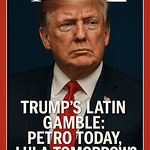
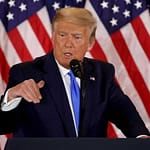
What he is, in Trump’s second term, is something more significant than a diplomat: he is a trusted ideological operative who has been explicitly assigned to Brazil. His appointment to a senior advisory role ‘overseeing Brazil’ last month was not a routine bureaucratic decision. It was a signal — about how Washington views the current Brazilian government, about the channels through which U.S.-Brazil policy will actually be made, and about the degree to which the Trump administration treats the Bolsonaro prosecution not as a settled legal matter but as an ongoing political injustice requiring active American engagement.
Beattie has been unambiguous about his views. He has called Supreme Court Justice Alexandre de Moraes — the judge who convicted Jair Bolsonaro, who oversees the Bolsonaro-related prosecutions, and who is also the official who authorized Beattie’s prison visit — ‘the key architect of the censorship and persecution complex directed against Bolsonaro.’ That description was not offered in a private conversation. It was published on X, the platform owned by Elon Musk, which has become a primary distribution mechanism for the global conservative movement. Moraes, whose court authorized the visit, thus finds himself in the surreal position of admitting into the prison he administers a man who has publicly called him a persecutor.
Beattie is not a diplomat. He is an ideological operative assigned specifically to Brazil, whose views on Bolsonaro’s prosecution align precisely with Trump’s. His prison visit is less a diplomatic call than a statement of alignment.
The tariff episode of August 2025 makes the stakes concrete. When Trump raised tariffs on Brazilian exports to 50 percent — in a letter explicitly citing the Bolsonaro prosecution as justification, calling it a ‘Witch Hunt that should end IMMEDIATELY’ — he demonstrated that American economic pressure is directly, explicitly linked to the treatment of his political ally. Most of those tariffs were subsequently rolled back as part of the cautious rapprochement that the Lula government labored to construct in the second half of 2025. But the episode established a template: the Bolsonaro file is not separate from the trade relationship, the FTO designation timeline, or the security architecture of the Shield of the Americas. It is woven through all of them.
The Senator Who Walks In Like a President
When Flávio Bolsonaro walked into the ‘Generation of Truth’ antisemitism conference in Jerusalem in February 2026, the Jerusalem Post correspondent who covered his arrival noticed something remarkable. His entourage was vast. Security pressed the crowd back. Every few steps, someone reached for a selfie. Brazilian olim — immigrants to Israel — hovered nearby with what the reporter described as the kind of grin people save for weddings and World Cup goals. Aides had already taken to addressing him as ‘Mr. President.’
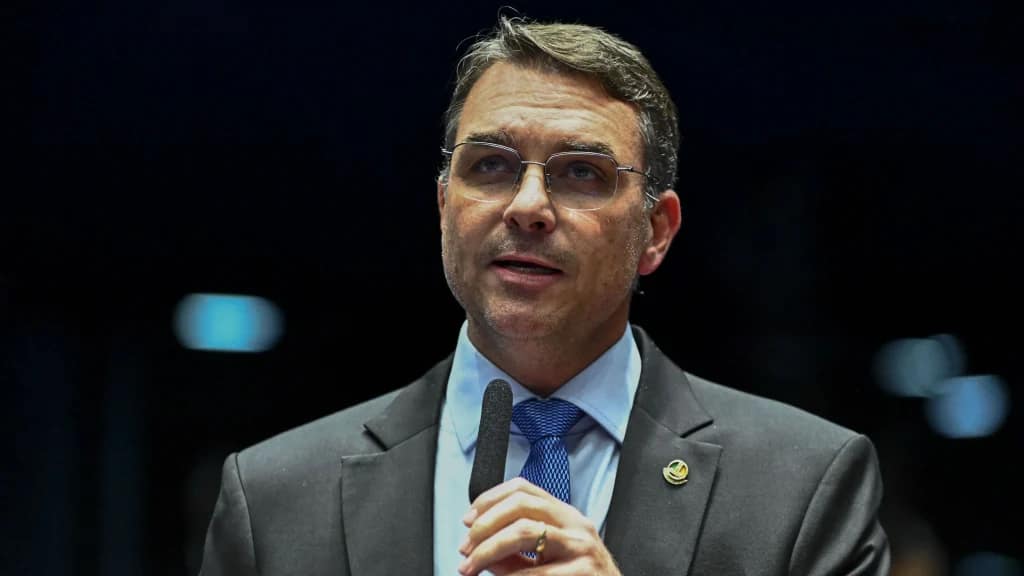
The 44-year-old senator from Rio de Janeiro is, visually and temperamentally, almost a replica of his father — the same bearing, the same directness, the same capacity to occupy a room. He had opened his Jerusalem address with a line in English, a language he does not speak fluently, precisely because it was a statement of intent: ‘I speak here today not only as a senator but as a candidate for the presidency of Brazil.’ The line landed in the room, and on the global conservative internet, as a declaration.
His international itinerary in the months since his father’s December endorsement has been a systematic tour of the coordinates of global right-wing power. Israel first — where he toured the West Bank settlements of Samaria, prayed at the Western Wall, met with Diaspora Affairs Minister Amichai Chikli, and pledged to move Brazil’s embassy from Tel Aviv to Jerusalem, to rejoin the International Holocaust Remembrance Alliance, and to align Brazil with Javier Milei’s ‘Isaac Accords’ — a South American initiative explicitly modeled on the Abraham Accords. Then Bahrain. Then the United Arab Emirates. Then the margins of the Shield of the Americas summit in Doral, where his brother Eduardo lobbied Milei and Bukele on the FTO designation.
The Israel alignment is not incidental. It is architecturally central to the international network Flávio is assembling. Brazil has the ninth-largest Jewish community in the world and the second-largest in Latin America, with over 107,000 Brazilian Jews — a community deeply influential in São Paulo’s financial and media sectors. Under Lula, Brazil-Israel relations cratered spectacularly: Lula compared Israel’s Gaza war to the Holocaust in February 2024, Israel declared him persona non grata, ambassadors were recalled, and the relationship that Jair Bolsonaro had spent four years building as what he called Israel’s ‘new best friend’ was dismantled with remarkable thoroughness. A Flávio presidency would represent a complete reversal — and, crucially, a reconnection with the American Jewish political network that intersects deeply with the Trump political coalition.
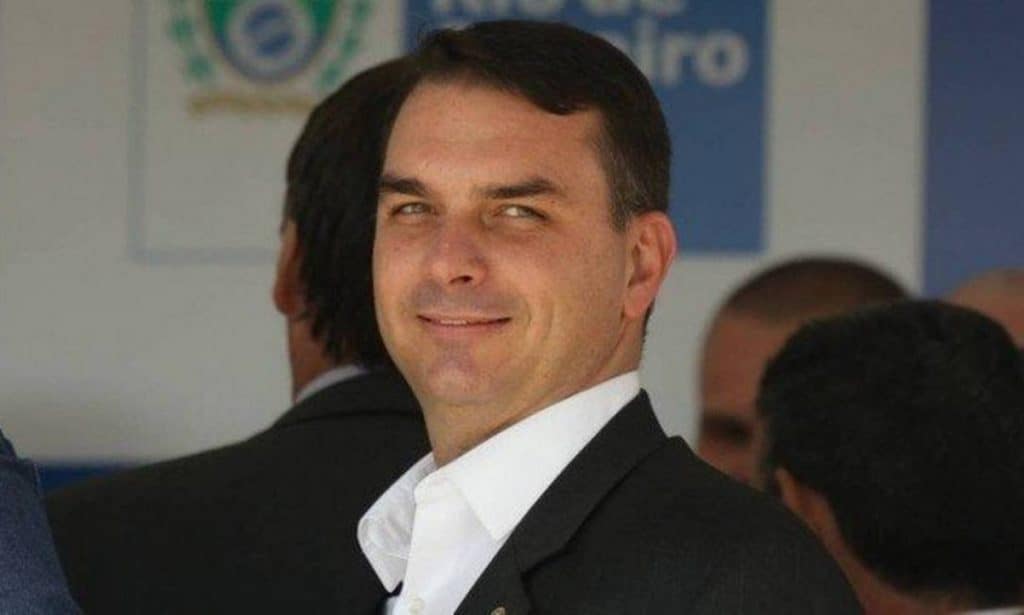
‘I am certain I will win,’ Flávio told Israel Hayom. ‘Beyond the belief that this is God’s will, Brazilians cannot endure another four years of incompetence and corruption under Lula.’ He added: ‘Brazil is the missing link to defeating international criminals and terrorists in South America.’
That last line — ‘the missing link’ — is the most revealing thing Flávio has said about his strategic vision. It is a direct address to Washington: under a Bolsonaro government, Brazil would not resist the Shield of the Americas. It would complete it. The FTO designation of PCC and Comando Vermelho would not need to be a coercive act of external pressure; it would become a jointly celebrated policy alignment between partners rather than an American imposition on a resistant sovereign. The counter-cartel infrastructure that Lula sees as a threat to Brazilian sovereignty would, under Flávio, be invited in.
The Polls: A Race That Nobody Thought Possible
The trajectory of the polling numbers is, for Lula’s government, alarming. When Flávio announced his candidacy in December 2025, Bloomberg reported that Lula was ‘far ahead.’ By January 21, Flávio had solidified as ‘the main challenger’ but was still substantially behind in head-to-head scenarios. By February 25, a Bloomberg headline reported something that would have seemed improbable six months earlier: ‘Flávio Bolsonaro Pulls Even With Lula in Brazil Election Poll.’ And on March 7, 2026 — the day of the Shield of the Americas summit in Doral — Datafolha published the most consequential survey yet: in a potential runoff, Lula would receive 46 percent of the vote to Flávio’s 43 percent. Within the margin of error. A technical tie.
The movement is stunning. Flávio closed what had been a 12-point gap in approximately ten weeks. The proximate causes are multiple: the Shield of the Americas has put security and organized crime at the center of the political conversation, an issue on which Lula is deeply vulnerable; the FTO designation debate has allowed the Bolsonaro camp to portray the PT as protecting terrorists; the Beattie appointment and the prison visit have demonstrated, in a form accessible to every Brazilian voter, that Washington’s heart remains with the Bolsonaro family; and Flávio himself has performed considerably better on the international stage than skeptics anticipated.
The rejection numbers are the most instructive detail in the Datafolha survey. About 45 percent of Brazilians say they would not vote for Lula under any circumstances. About 50 percent say the same about Flávio. This is the core structural challenge of Brazilian politics: both the leading candidates have roughly equivalent ceiling problems, roughly equivalent rejection rates, and roughly equivalent base support. The election will be decided in the middle — among the centrist voters who backed Lula narrowly in 2022 but are now expressing dissatisfaction with his management of the economy, security, and the FTO crisis that his foreign policy has helped create.
The fragmented right is the variable that could break the race either way. Governor Tarcísio de Freitas of São Paulo — for months the preferred candidate of financial markets and the PSD party machine — has declared he will not run and endorsed Flávio. Governor Romeu Zema of Minas Gerais has entered the race independently, potentially splitting the anti-Lula vote in Brazil’s second-largest state. The PSD, led by power-broker Gilberto Kassab, is still negotiating which candidate it will mobilize its formidable patronage machine behind. If the opposition unites behind Flávio — which is not guaranteed, given the family’s polarizing legacy — a second-round scenario becomes genuinely competitive.
The Paradox: Sovereignty Through Submission?
The deepest irony of Brazil’s current predicament is the one that Lula cannot easily speak aloud, because speaking it means acknowledging the coherence of the opposing argument. The argument runs as follows: the sovereignty that Lula is fighting to protect — the legal and diplomatic independence to designate Brazil’s criminals on Brazil’s terms, according to Brazilian law, without external pressure — has already been significantly compromised. Not by the FTO designation, which has not yet happened, but by the very dynamics that make it possible: the PCC and Comando Vermelho have grown so large, so transnational, so embedded in Brazil’s financial and political systems, that they have become, in practice, a constraint on Brazilian sovereignty. A state that cannot enforce its own laws in hundreds of favela communities, that watches its most powerful port export billions of dollars of cocaine to Europe annually, and that has seen a federal operation kill 122 people without degrading the target organization’s capacity, is not a fully sovereign state in the most meaningful sense of the word.
Flávio Bolsonaro’s argument — delivered explicitly to an Israeli audience, implicitly to an American one — is that the path to genuine sovereignty runs through partnership with the United States, not resistance to it. Join the Shield of the Americas, embrace the FTO designation as a domestic political choice rather than accepting it as external coercion, invite American intelligence and security cooperation on Brazilian terms, and the result is a Brazil that is diplomatically rehabilitated, economically rewarded, and actually capable of doing what Lula has been unable to do: reduce the operational capacity of the organizations that have made the word ‘sovereignty’ feel hollow in the communities where they operate.
It is a coherent argument. It is also, in the hands of the Trump administration, a weapon. Because the conditions under which it becomes available — an FTO designation pending, tariff threats on the table, a Trump adviser in a Brazilian prison, a Bolsonaro polling at 43 percent — are conditions that the Trump administration has itself helped create. Washington is not a neutral observer of the question of whether Flávio Bolsonaro wins in October. It is, through the accumulation of its policy choices, an active participant in creating the conditions under which a Bolsonaro victory becomes more likely.
Eduardo Bolsonaro — currently under investigation by Brazil’s Supreme Court for obstruction of justice, facing charges that explicitly cite his attempts to petition Trump for help in his father’s case — has made this explicit in his own characteristic style. The case against him is, in part, premised on the allegation that he used his relationship with figures in Trump’s orbit to attempt to influence Brazilian legal proceedings through economic and diplomatic pressure. That case may ultimately make more noise than impact. But it documents, in a Brazilian court record, exactly what critics of the Bolsonaro network have long argued: that the family has been actively soliciting American intervention in Brazilian domestic politics, with at least partial success.
The Jair Question: Pardon, Prison, and the Father’s Shadow
The subtext of every conversation about Flávio Bolsonaro’s candidacy is the father in his prison cell, recovering from double hernia surgery, having fallen from his bed in January, barred from house arrest despite multiple health emergencies, and now receiving a Trump adviser in what is, simultaneously, a pastoral visit and a geopolitical statement.
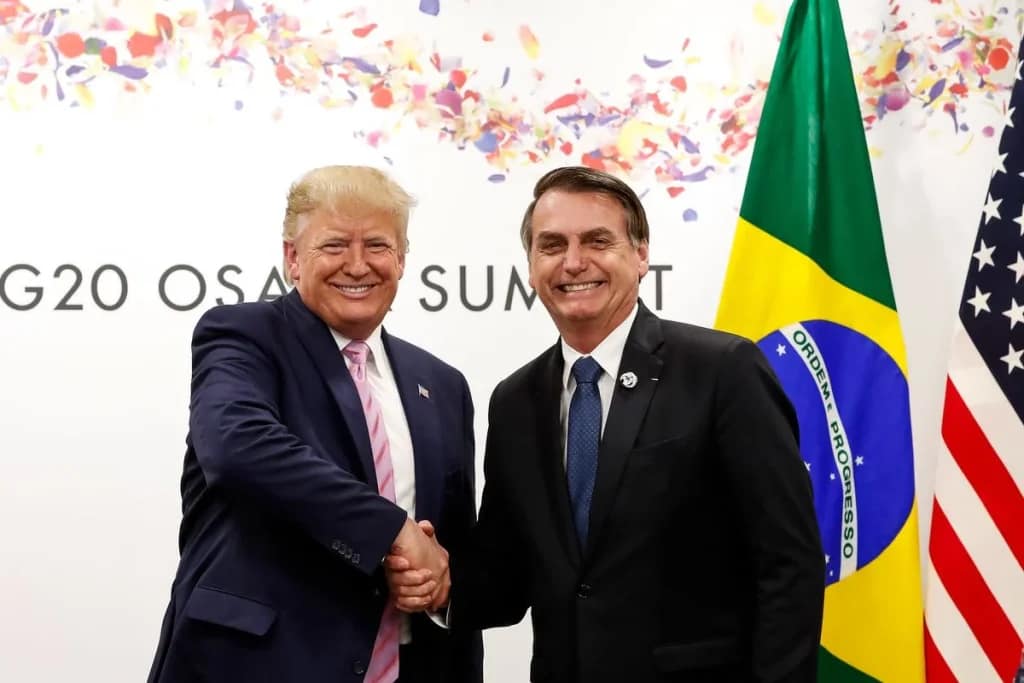
Jair Bolsonaro was convicted by a panel of Supreme Court justices in September 2025 of attempting to overthrow Brazil’s democratic system, leading an armed criminal organization, and plotting to assassinate Lula, Vice President Geraldo Alckmin, and Justice de Moraes. He was sentenced to 27 years. His appeal was denied. He began serving his sentence in November. He is 70 years old, in declining health, and ineligible to hold political office until 2030 even if he were to be released.
Flávio has been explicit: his first act as president would be to pardon his father. He walked back a statement in which he suggested his candidacy’s ‘price’ was his father’s freedom — the words were politically damaging because they made the transaction too visible — but the underlying commitment has never been retracted. A Flávio Bolsonaro presidency means Jair Bolsonaro walks out of prison. And a Jair Bolsonaro who walks out of prison is, in the eyes of his base, the validation of everything the family has argued for three years: that the prosecution was a politically motivated witch hunt, that the conviction was illegitimate, and that the judiciary that imposed it has been defeated.
The implications for Brazilian democracy are profound and, in some analyses, alarming. The Supreme Court — and particularly Justice de Moraes, who has become the institutional symbol of the Bolsonaro legal battle — would face a crisis of authority the moment a President Flávio Bolsonaro signed a pardon decree. The democratic institutions that prosecuted Jair Bolsonaro were not acting arbitrarily; they were responding to what a panel of judges determined was an actual, documented attempt to seize power illegally. A pardon does not erase that record. It simply releases the man it convicted and, in doing so, rewrites the political meaning of what was done.
A Flávio presidency means a Jair pardon. And a Jair pardon, issued by a son the father endorsed from his prison cell, rewrites the political meaning of the entire democratic drama that has consumed Brazil since 2022.
Closing the Circle: What October Decides
Five articles into this series on the Shield of the Americas, the arc of the argument is visible. What the Trump administration assembled in Doral on March 7, 2026, was not merely a security coalition. It was a realignment of the hemisphere along ideological lines — and that realignment has a specific, intended consequence for Brazil: to make the political cost of resistance so high that either Lula capitulates, or Lula loses, or both.
The convergence is striking. The FTO designation presses on Brazil’s financial sovereignty and generates a domestic political crisis. The Beattie appointment and prison visit demonstrate that Washington views the Bolsonaro prosecution as unfinished political business. The Shield of the Americas summit excludes Brazil and makes visible the cost of exclusion. Eduardo Bolsonaro lobbies at Doral for faster action on the designation. Flávio polls at 43 percent in a country where 45 percent say they will never vote Lula. And a Trump adviser sits down with Jair Bolsonaro in his cell, seven months before Brazilians go to the polls.
The irony that Lula cannot escape — the paradox at the center of his dilemma — is this: the sovereignty argument that animated his foreign policy and his resistance to the Shield of the Americas depends on Brazilian institutions being strong enough to exercise sovereignty meaningfully. But those institutions have been visibly failing to address the PCC and Comando Vermelho for decades. The FTO designation is, among other things, a diagnosis of that failure. And the candidate proposing to fix the failure is the one who has promised, as his first act in office, to pardon the man convicted of trying to destroy the very institutions that are supposed to protect sovereignty in the first place.
Brazil’s October election is not, in the end, merely a contest between two men and two parties. It is a referendum on what kind of sovereignty is possible for Latin America’s largest democracy in an era when the United States has demonstrated, in Venezuela and Ecuador and El Salvador, that it has both the will and the capacity to reshape its neighborhood according to its preferences — and when those preferences include, explicitly and specifically, the removal of left-wing governments that resist alignment, the use of economic and legal tools to alter domestic political outcomes, and the cultivation of opposition movements whose success would transform the hemisphere’s security architecture.
Lula came to power in 2022 promising to restore Brazil’s place in the world. He will stand for reelection in October defending a version of Brazilian sovereignty that is, by any honest accounting, already under pressure it has not previously faced. His opponent will stand on a stage in Washington’s favor, Jerusalem’s embrace, and a prison endorsement from a father who remains, despite everything, the most recognizable face of Brazil’s populist right.
Seven months remain. The Datafolha numbers are moving in one direction. The man from Trump’s orbit has a prison appointment next week. And somewhere in a federal penitentiary in Brasília, Jair Bolsonaro is waiting for a visitor — and, perhaps, for something larger: the vindication that, in the brutal arithmetic of hemispheric politics, looks less impossible today than it did the morning after he lost.
— ◆ —
SHIELD OF THE AMERICAS · SERIES COMPLETE
Part I: The Summit · Part II: Guyana · Part III: Suriname · Part IV: Brazil’s Dilemma · Part V: The Heir and the Jailhouse
March 11, 2026