


Suriname Is Part of the Climate Solution

An opinion piece on behalf of Suriname by Anton JieSamFoek
As the world searches for ways to confront the climate crisis, one conclusion is becoming unavoidable: cutting emissions alone will not be enough. Climate science is clear. Alongside rapid emissions reductions, we must also remove carbon dioxide already in the atmosphere. What has gone up must now come down.
In this global debate, attention is usually focused on large industrial nations, breakthrough technologies, and capital-intensive solutions. Far less attention is paid to a more basic question: which countries are already contributing to climate stability — and under what conditions are they prepared to keep doing so?
Suriname is one of those countries.
A Country That Already Delivers
More than 93 percent of Suriname is covered by intact tropical rainforest. This is not a future aspiration; it is today’s reality. For years, Suriname has been carbon-negative, absorbing more carbon than it emits. In a world struggling to slow emissions growth, this is not symbolic — it is structurally important.
Related Posts:
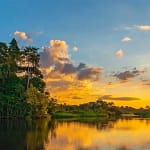







This outcome did not occur by chance. It reflects deliberate choices: limited deforestation, long-term ecosystem protection, and the understanding that natural wealth is more than a commodity to be extracted and sold.
From Protection to Carbon Removal
The global climate agenda, however, is evolving. Protecting existing carbon sinks remains essential, but it is no longer sufficient. Scientific consensus now points to the need for active carbon removal: restoring ecosystems, increasing long-term storage in soils and mangroves, and carefully deploying technology where appropriate.
Suriname is well positioned to contribute to this next phase.
We have vast forest areas suitable for ecological restoration using native species. We have extensive mangrove systems along our coast — among the most efficient natural carbon sinks on Earth. We have agricultural landscapes where soil-based carbon storage and biochar can simultaneously strengthen food security and climate resilience.
But Suriname will not play this role at any cost.
No Offsets at the Expense of People or Nature
Global carbon markets remain immature and unevenly regulated. Too often, projects promise climate benefits on paper while delivering land dispossession, monocultures, or social disruption on the ground. That model is neither sustainable nor ethical.
Suriname will not become a source of cheap carbon offsets for others to continue business as usual.
Our conditions are straightforward:with respect for Indigenous and Maroon land rights, no large-scale monocultures disguised as climate solutions, transparent governance and public accountability, local economic value creationand independently verifiable climate impact
Carbon removal that undermines communities or ecosystems is not climate action. It is greenwashing.
Partnership, Not Dependency
We invite the international community to engage with Suriname not as an aid recipient, but as a strategic partner. A partner in developing high-integrity carbon removal. A partner in safeguarding tropical ecosystems critical to global stability. And, importantly, a partner in demonstrating that climate action and social justice do not have to be in conflict.
Investment in Suriname support not only long-term carbon storage or biodiversity protection but also coastal resilience, social and hopefully political stability in order to create the credibility of global climate commitments
These are not abstract benefits. They are measurable contributions to shared global goals.
Climate Action Is Also About Trust
The climate crisis is not only a technological challenge. It is a crisis of trust — between North and South, between commitments and delivery, between ambition and implementation.
Suriname has already shown that a different path is possible. We have preserved our forests while many others did not. We have contributed to global climate stability without demanding constant attention or reward. As the world now turns toward carbon removal, we are prepared to deepen that contribution — carefully, fairly, and transparently.
But let us be clear: climate repair cannot be imposed. It must be built on mutual respect.
Suriname is ready to play its part.
The question is whether the global community is ready to engage on equal terms.
by Anton JieSamFoek
Amsterdam, 30 January 2026